Английский Культура
06.07.2026 Читать источник
Джейси Айзенберг заявил, что третья часть Zombieland зависит от желания Эммы Стоун
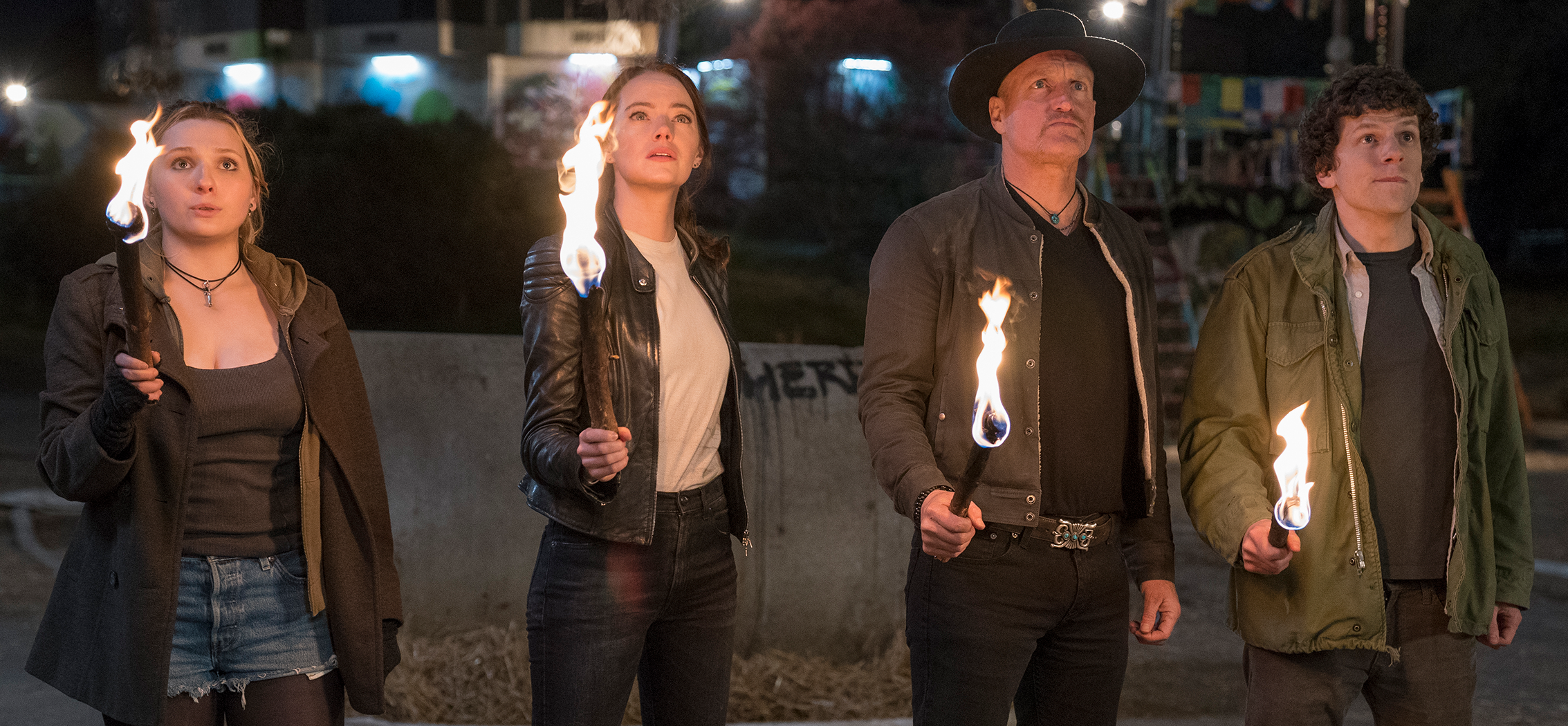
Актер Джейси Айзенберг сообщил, что съемки долгожданного сиквела фильма Zombieland возможны только при согласии Эммы Стоун. Режиссер Рубен Флейшер ранее подтвердил план выхода картины в 2029 году, однако официальный сценарий пока не утвержден.
Перевод ИИ
Текст статьи доступен на языке оригинала.
Нажмите кнопку «Перевести статью» выше, чтобы сгенерировать перевод с помощью ИИ.
Оригинальный контент
Jesse Eisenberg placed Zombieland 3's fate squarely in one person's hands last week. Speaking to reporters during the press circuit for Minions & Monsters — currently in its fifth day of US theatrical release — Eisenberg and co-star Zoey Deutch were asked whether their reunion in the Illumination animated film signals movement on the long-awaited horror-comedy threequel. Eisenberg's answer was direct: the sequel depends on whether Emma Stone wants to do it. "Probably up to Emma Stone. Let's be honest," Eisenberg said. "If she wants to do a Zombieland 3, I think we would."
That single condition matters now because director Ruben Fleischer already confirmed his intention months ago. In a November 2025 Deadline career retrospective, Fleischer said he hoped to release Zombieland 3 in 2029, maintaining the franchise's established 10-year cadence. No script has been formally greenlit. No production start date exists. And readers encountering a poster on Facebook claiming a July 2026 Zombieland 3 release should know it is fan-made — no such film is in production.
What Eisenberg and Deutch Actually Said About Zombieland 3
The Eisenberg-Deutch press reunion happened in the context of Minions & Monsters, in which Eisenberg voices Dort — an alien robot-overlord the Minions attempt to recruit as their next master — and Deutch voices Debbie, a suffragette who becomes romantically entangled with Dort. The two actors voiced their characters separately; Deutch told reporters she had "long craved" to work with Eisenberg again after their shared time on Zombieland: Double Tap.
When a ScreenRant interviewer asked Deutch directly whether the Minions & Monsters reunion came before or after Zombieland 3, her response was uncomplicated: "That's up to you, Jesse," Deutch said. Eisenberg, in turn, placed the timeline at approximately three years out, citing the franchise's unofficial rule. "I think in three years maybe, because we've done it every 10 years," he said. Then he named the actual obstacle: Stone's schedule.
Eisenberg himself is not idle in the interim. Since Zombieland: Double Tap, he earned an Oscar nomination for Best Original Screenplay for A Real Pain (2024) — a film he also directed — and is currently preparing The Debut, another writing-directing project he stars in alongside Paul Giamatti, Julianne Moore, and Halle Bailey. Deutch, meanwhile, has worked across Nouvelle Vague, Anniversary, and Invincible in the years since Double Tap.
Ruben Fleischer's 2029 Target, Explained
The decade-gap cadence is not a formal Sony contractual commitment — it originated as an offhand joke at the Double Tap press junket, widely attributed to Stone, that the franchise should simply return every ten years. That joke has since hardened into what functions as franchise policy. Fleischer told Deadline in November 2025 that he and the cast left Double Tap's press circuit with a standing agreement: "We'll see you in 10 years."
The math now makes 2029 a natural target: 2009 + 10 = 2019 (Double Tap); 2019 + 10 = 2029 (Zombieland 3). Fleischer was direct about where things stand: early conversations are underway, but nothing is locked. "I've got a few things that are raring to go," he told Deadline, "so we'll see which one comes first." Among those other projects: a Western vampire film he described as "Unforgiven if Clint Eastwood was a vampire," and a potential Now You See Me 4. Eisenberg and Woody Harrelson both appeared in Now You See Me: Now You Don't (released November 14, 2025), Fleischer's most recent feature — their fourth creative collaboration together.
Scheduling the Zombieland 3 cast is not trivial. Stone's current commitments — Cruella 2 and potential projects with director Yorgos Lanthimos — place her among the most in-demand actors in Hollywood. Abigail Breslin and Harrelson also carry full slates. If Fleischer wants a 2029 release, the development clock for script, greenlight, and production would need to start in earnest within the next 12 to 18 months.
Rhett Reese and Paul Wernick, who wrote both existing Zombieland films and also wrote the Deadpool franchise, would be the presumed writers for a third installment, though no confirmation of their involvement has been published.
Why Minions & Monsters Is Worth Seeing While Eisenberg and Deutch Are in Your Head
Minions & Monsters opened in US theaters on July 1, 2026, the third standalone Minions film and the seventh entry in the Despicable Me franchise. It is set in Hollywood in 1927 and follows an ancestral tribe of Minions who briefly become silent-film stars, only to be immediately undone by the arrival of synchronized sound. The film is currently playing in standard, Dolby, IMAX, and RealD 3D formats; it is not yet available for home viewing.
The casting is strong: Jeff Bridges, Allison Janney, and Christoph Waltz appear alongside Eisenberg, Deutch, and Trey Parker — who voices Goomi, a Lovecraftian squid-creature accidentally summoned from a warlock's spellbook. Director Pierre Coffin, who has voiced the Minions across every film in the franchise, returns, with Brian Lynch writing the script. George Lucas appears in a cameo as himself, recruited by producer Chris Meledandri.
The 1927 setting is not arbitrary. The Minions' tragedy in this film maps precisely onto one of the most consequential single-technology disruptions in media history: the commercial adoption of synchronized sound. The Vitaphone system — a 33⅓ rpm lacquer disc synchronized to a projector motor, developed by Western Electric and deployed by Warner Bros. — made The Jazz Singer (October 6, 1927) the first commercially successful feature-length film with synchronized dialogue sequences. The Minions, whose language (Minionese, a constructed blend of Bantu, French, Spanish, and English fragments with no stable phonemic inventory) is incomprehensible in any medium, were unusable in a sound context. Their failure is historically accurate: actors with heavy foreign accents or regional speech patterns that had been invisible in silent film faced exactly this compatibility collapse when the microphone arrived.
Vitaphone's disc system was itself quickly superseded by optical sound-on-film — a variable-area soundtrack photographically encoded as a stripe along the film strip's edge and read by a photoelectric cell — which remained the fallback format on 35mm release prints for decades afterward. The Minions, in their 1927 Hollywood adventure, experience the leading edge of this disruption firsthand.
The Shadow-Geometry of Horror: What Minions & Monsters Gets Right About German Expressionism
The film's second half transitions into a visual register drawn from German Expressionist cinema — the chiaroscuro lighting and elongated shadows characteristic of F.W. Murnau's Nosferatu (1922) and Robert Wiene's The Cabinet of Dr. Caligari (1920). This aesthetic is not simply a period-accurate stylistic choice; it represents the visual grammar from which Western horror as a genre descends.
The mathematics of those shadows are real. A point light source elevated at a shallow angle to a subject produces a shadow whose length equals the subject's height divided by the tangent of the elevation angle. At a lamp elevation of 5°, a 2-meter figure casts a 22-meter shadow. Expressionist cinematographers did not calculate these ratios explicitly, but they mastered their application empirically — using orthochromatic film stock (insensitive to red, rendering skin tones nearly white and shadows near-absolute black) to force meaning through silhouette, angle, and architectural distortion rather than color or texture. The result exploits a specific property of threat-detection circuitry in the brain: high-contrast stimuli activate the amygdala more reliably than low-contrast ones, which is why horror and suspense genres have converged on this aesthetic regardless of era.
The motion illusion that makes all of this cinema possible rests on two distinct neurological phenomena operating together: the phi phenomenon (identified by Max Wertheimer in 1912, in which the brain interpolates apparent motion between static images presented in rapid succession) and flicker fusion, above approximately 16 frames per second, at which the brain ceases to perceive discrete frames and registers continuous motion. Cinema at 24fps operates well above both thresholds. Every frame of Minions & Monsters — Expressionist shadows included — is a still image that the visual system reconstructs into motion.
How the Zombie Franchise's Science Holds Up
The Zombieland franchise establishes its apocalypse as originating from a mutated version of mad cow disease (bovine spongiform encephalopathy, or BSE), transmitted via a contaminated burger. This is prion disease territory — the most conceptually unusual class of infectious pathogen. Prions are not viruses. They carry no nucleic acid. They are misfolded proteins that propagate by inducing structural conformational changes in normal cellular proteins, converting them to the pathological form through a chain reaction requiring no genetic material to transmit. Their resistance to heat, radiation, and most disinfectants makes them extraordinarily difficult to destroy. The Nobel Prize–winning research of Stanley Prusiner established these mechanisms.
BSE and its human variant (vCJD) primarily damage the cerebral cortex and cerebellar structures, producing progressive cognitive decline, psychiatric disturbances, and motor dysfunction, as documented in a 2026 narrative review of prion disease brain-region effects. The franchise's fictional Z-virus extrapolates from this biology in a scientifically plausible direction: a pathogen that selectively spares the subcortical motor circuits and survival drives while ablating cortical inhibitory control would produce behaviorally something close to the franchise's zombies. The real neuroscience does not rule this out as a trajectory for a sufficiently engineered pathogen; it simply offers no known mechanism that achieves it.
The franchise's most interesting scientific gesture is the emergence of distinct zombie subspecies in Double Tap — the Homer (slow, stupid), the Hawking (intelligent), the T-800 (unkillable) — which implies the pathogen is evolving under selection pressure over the course of the outbreak. Population-level behavioral divergence within an outbreak is a real epidemiological dynamic: influenza, SARS-CoV-2, and rabies all produce phenotypically variable outcomes depending on host genetics and viral strain variation. A zombie pathogen that drives behavioral selection would, over time, produce variant strains. The franchise was doing population genetics comedy before most audiences knew what selection pressure meant.
Nature has already evolved real behaviour-modification strategies that parallel the franchise's fictional zombie biology. The rabies virus engineers biting compulsion in infected animals — a transmission technology: the virus generates the behavior that projects it into a new host via saliva. Ophiocordyceps unilateralis compels infected ants to climb to a specific height and bite into plant tissue, positioning the fungus's spore-releasing fruiting body at the optimal dispersal altitude — host-specific precision manipulation, not general neurotoxicity. Toxoplasma gondii, estimated to infect 30–50% of the global human population in latent form, has been linked in epidemiological studies to measurable shifts in risk tolerance and fear responses in rodents. Columbus's Rule #1 (Cardio) would not have helped against any of them.
Which brings the article back to Columbus's rules. The franchise's rule system — pre-committed behavioral protocols designed to reduce cognitive load in time-compressed, high-stakes situations — maps directly onto what the cognitive science literature calls naturalistic decision-making. Experienced firefighters, pilots, and military commanders are faster and more accurate in crisis not because they reason better under pressure, but because they have internalized rules that allow pattern-matching rather than deliberation. The prefrontal cortex, which supports flexible reasoning, is impaired by cortisol and adrenaline under acute stress. Columbus, as written, is a character whose anxiety disorder accidentally prepared him for the only conditions under which rule-based cognition outperforms improvisational cognition.
Zombieland 3, if it arrives in 2029, will inherit all of this as its scientific substrate — and will need to find a new decade's worth of anxiety to satirize. In 2009, the franchise processed late-Bush-era institutional collapse. In 2019, it processed social-media saturation and the fracturing of shared reality. By 2029, it may have AI, climate anxiety, and a deepened distrust of every institution the franchise has ever let its characters reach for. The found-family structure — people who should have nothing in common holding each other together through catastrophe — has consistently mapped onto whatever collective dread a decade produces. Emma Stone's schedule permitting.
Frequently Asked Questions
Is Zombieland 3 officially confirmed?
No. As of July 5, 2026, no script has been greenlit, no production start date exists, and Sony Pictures has made no formal announcement. Director Ruben Fleischer expressed hope for a 2029 release in a November 2025 Deadline interview, and Jesse Eisenberg has indicated general willingness to return — but both statements are aspirational. The project's status is: in early informal discussion, contingent on Emma Stone's availability and schedule.
What did Jesse Eisenberg say about Emma Stone and Zombieland 3?
Eisenberg said the project is "probably up to Emma Stone," adding that if she wants to make a third Zombieland, the rest of the cast would follow. He made these comments during the press circuit for Minions & Monsters, in which he and co-star Zoey Deutch reunite as voice actors. Eisenberg also estimated — based on the franchise's 10-year cadence (2009, 2019) — that 2029 is the most plausible window.
What is the viral Zombieland 3 poster claiming a July 2026 release?
It is fan-made. No Zombieland 3 film is in production as of today, and there is no July 2026 release scheduled or announced. The poster circulating on Facebook is not official and should not be treated as a real announcement.
Does Minions & Monsters connect to the Zombieland universe?
Not narratively. The connection is the actors: Jesse Eisenberg and Zoey Deutch, who played Columbus and Madison in Zombieland: Double Tap (2019), reunite as voice actors in Minions & Monsters (2026). The film is set in 1927 Hollywood and belongs entirely to the Despicable Me / Minions franchise. It is not a crossover and contains no Zombieland story elements. Both original Zombieland films are currently available to stream on Netflix.
ⓒ 2026 TECHTIMES.com All rights reserved. Do not reproduce without permission.
Аналитика ИИ и парсинга
Технические детали обнаружения, сопоставления и связывания статьи
Поисковый запрос
«Джесси Айзенберг Эмма Стоун Zombieland 3 третий фильм»
Запрос, сгенерированный ИИ для поиска статьи в веб-источниках
Связанные результаты поиска
Результаты поиска отсутствуют в БД
Парсер не сохранил результаты веб-поиска для этой статьи.