Английский Медицина
16.07.2026 Читать источник
Длительность ежедневных приступов зуда оказалась главным фактором, снижающим качество жизни пациентов с хроническими кожными заболеваниями
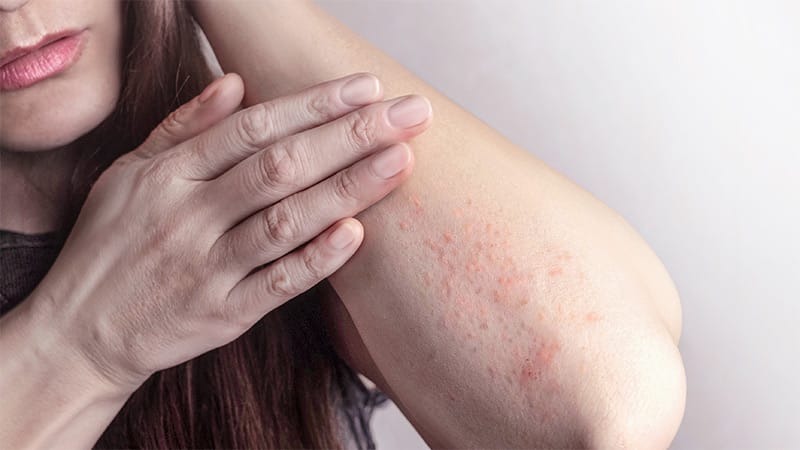
Исследование 522 пациентов показало, что именно продолжительность ежедневного зуда сильнее всего влияет на качество жизни, уступая лишь нарушениям сна и частоте расчесов. Авторы подчеркивают, что целенаправленная терапия этих симптомов критически важна для улучшения состояния пациентов с псориазом, атопическим дерматитом и другими дерматозами.
Перевод ИИ
Текст статьи доступен на языке оригинала.
Нажмите кнопку «Перевести статью» выше, чтобы сгенерировать перевод с помощью ИИ.
Оригинальный контент
TOPLINE
In a study involving patients with chronic pruritic dermatoses, daily itch duration emerged as the strongest mediator between disease severity and quality-of-life impairment, followed by sleep disturbance, scratching frequency, and average itch intensity.
METHODOLOGY
- Researchers conducted a prospective cross-sectional study including 522 adult patients (median age, 56 years) with chronic pruritus arising from psoriasis (n = 174), atopic dermatitis (n = 182), chronic prurigo (n = 108), or chronic urticaria (n = 58) from dermatologic centres across Germany between September 2018 and October 2020.
- Participants completed validated questionnaires assessing worst and average itch intensity (measured using the numerical rating scale), impairment of quality of life (measured using the five-item pruritus life quality [5PLQ] scale), daily time with itch, scratching frequency, and sleep disturbance.
- Disease severity was evaluated using validated disease-specific scales including the Eczema Area and Severity Index for atopic dermatitis, the Psoriasis Area and Severity Index for psoriasis, the Investigator's Global Assessment-Chronic Prurigo for chronic prurigo, and a non-validated Investigator's Global Assessment (IGA) scale for chronic urticaria.
- The researchers assessed associations between quality of life, disease severity, and itch-related factors.
TAKEAWAY
- Quality-of-life scores assessed using the 5PLQ questionnaire correlated weakly with disease severity (correlation coefficient [r], 0.201; P < .001) but strongly with itch-related factors including daily itch duration, scratching frequency, sleep disturbance, and average itch intensity (r, 0.515-0.603; P < .001 for all).
- In multivariable regression, 5PLQ scores were positively associated with female sex (regression coefficient [β], 0.887; P = .003), moderate disease severity (β, 1.552; P = .032), scratching frequency (β, 0.370; P < .001), and sleep disturbance (β, 0.427; P < .001).
- Daily itch duration showed the strongest mediating effect on the relationship between disease severity and quality-of-life impairment (indirect β, 0.270; P < .001), followed by sleep disturbance (indirect β, 0.235; P = .006), scratching frequency (indirect β, 0.205; P = .010), and average itch intensity (indirect β, 0.168; P = .049).
- Worst itch intensity on the numerical rating scale did not demonstrate a significant mediating role in the association between overall disease severity and 5PLQ scores.
IN PRACTICE
"Daily itch duration, sleep disturbance, scratching frequency, and average itch intensity significantly mediate the effect of disease severity on quality of life," the authors wrote. "Assessing these itch-related parameters and addressing them with targeted therapeutic interventions is thus of pivotal importance to improve the quality of life in this complex patient population," they added.
SOURCE
The study was led by Manuel P. Pereira, Institute of Allergology, Charité - University Medical Center Berlin, Berlin, Germany. It was published online on July 07, 2026, in Dermatology and Therapy.
LIMITATIONS
The researchers computed an overall severity variable by coding clinician-reported outcomes for each diagnosis into a 0-3 scale. The severity of chronic urticaria was assessed with a non-validated IGA scale. Sample sizes of patient groups were not homogeneous, reflecting varying disease prevalence in the population.
DISCLOSURES
This study received support from an unrestricted grant provided by Novartis Pharma GmbH. Pereira disclosed receiving research funding from Almirall, Clinuvel, LEO Pharma, and Pfizer; serving as an investigator for Amgen, Allakos, ARS Pharmaceuticals, Celldex Therapeutics, Escient, Incyte, InflaRx, Mitsubishi, and Sanofi; receiving consulting fees from Almirall, Amgen, Galderma, Incyte, Novartis, and Sanofi; and receiving speaker honoraria and/or travel fees from multiple organisations including AbbVie, Amgen, Beiersdorf, Celltrion, CSL Behring, and others. Full disclosures are noted in the original article.
This article was created using several editorial tools, including AI, as part of the process. Human editors reviewed this content before publication.
Аналитика ИИ и парсинга
Технические детали обнаружения, сопоставления и связывания статьи
Поисковый запрос
«влияние длительности ежедневных приступов зуда на качество жизни пациентов с хроническими кожными заболеваниями»
Запрос, сгенерированный ИИ для поиска статьи в веб-источниках
Связанные результаты поиска
Результаты поиска отсутствуют в БД
Парсер не сохранил результаты веб-поиска для этой статьи.