Английский Экология
08.09.2026 Читать источник
Критика проекта NMIA: инженеры не могут гарантировать безопасность строительства аэропорта на дельте
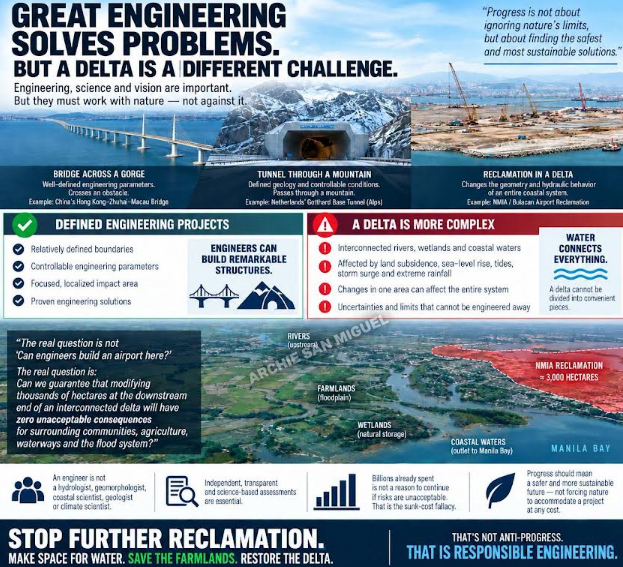
Эксперты подчеркивают, что сложность природных систем дельты делает невозможной гарантию отсутствия негативных последствий для окружающей среды и населения. Для реализации проекта необходимо не только инженерное решение, но и независимые научные оценки рисков, а не оправдание затрат уже вложенных средств.
Перевод ИИ
Текст статьи доступен на языке оригинала.
Нажмите кнопку «Перевести статью» выше, чтобы сгенерировать перевод с помощью ИИ.
Оригинальный контент
Sunk-cost fallacy
FOR ENGINEERS who defend the NMIA project – or for anyone who defends it simply because billions have already been spent:
I RESPECT your experience as an engineer, but I would respectfully disagree with one important point: science and engineering cannot honestly guarantee 100% success when dealing with a complex natural system like a delta.
An engineer can design a bridge across a gorge or a tunnel through the Alps because these projects involve relatively defined engineering parameters. A living delta is fundamentally different.
An engineer is not automatically a hydrologist, geomorphologist, coastal scientist, geologist, environmental scientist, or climate scientist. Engineering is essential, but an airport built on thousands of hectares of reclaimed delta requires these disciplines to work together.
The question is not: “Can engineers build an airport here?”
Of course they can build remarkable structures.
The real question is: “Can we guarantee that modifying thousands of hectares at the downstream end of an interconnected delta will have zero unacceptable consequences for surrounding communities, agriculture, waterways and the flood system?”
That is a much harder question.
You cannot simply engineer away land subsidence, sea-level rise, tides, storm surge, extreme rainfall, or the enormous volume of water entering a delta. These risks can be mitigated and managed, but they cannot honestly be declared nonexistent.
And comparing NMIA with a bridge across a gorge or a tunnel through the Alps misses a fundamental difference:
A bridge crosses an obstacle.
A tunnel passes through a mountain.
Reclamation changes the geometry and hydraulic behavior of a coastal system.
In a delta, water connects everything.
That is why confidence in technology must be accompanied by independent hydrological, geological, coastal, environmental and climate assessments, transparent modelling, and long-term monitoring—not simply faith in technology, money, or the vision of one businessman.
And being critical of reclamation does not make someone “pessimistic.” Sometimes skepticism is precisely what responsible engineering requires.
VISION IS IMPORTANT.
ENGINEERING IS IMPORTANT.
SCIENCE IS ESSENTIAL.
BUT NONE OF THEM GIVE US PERMISSION TO IGNORE NATURE’S LIMITS.
Most importantly, billions already spent cannot become the justification for continuing a project if independent evidence shows unacceptable environmental or public risks.
That is the sunk-cost fallacy: money already spent is gone. It should not determine whether we spend even more.
Progress should mean finding the safest and most sustainable solution—not proving that we can force nature to accommodate a project at any cost.
The burden of proof should be on the project:
Demonstrate, through transparent and independent science, that this massive intervention will not place the delta and its communities at unacceptable risk.
That’s not anti-progress.
THAT IS RESPONSIBLE ENGINEERING.
Аналитика ИИ и парсинга
Технические детали обнаружения, сопоставления и связывания статьи
Поисковый запрос
«критика проекта NMIA безопасность аэропорт дельта»
Запрос, сгенерированный ИИ для поиска статьи в веб-источниках
Связанные результаты поиска
Результаты поиска отсутствуют в БД
Парсер не сохранил результаты веб-поиска для этой статьи.