Английский Медицина
06.07.2026 Читать источник
Дерматологи призывают переходить от реактивного к проактивному лечению псориаза с ранним применением биологических препаратов
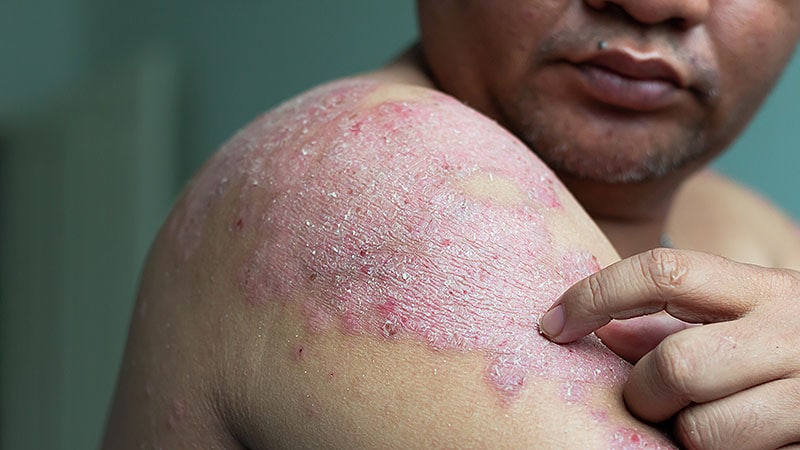
Эксперт Крис Гриффитс заявил, что современная система лечения псориаза слишком медленна и требует смены стратегии на раннее комплексное вмешательство. Анализ показал, что пациенты, получившие биологическую терапию в качестве первого курса, достигли полного очищения кожи в 58% случаев против 32% при использовании традиционных методов.
Перевод ИИ
Текст статьи доступен на языке оригинала.
Нажмите кнопку «Перевести статью» выше, чтобы сгенерировать перевод с помощью ИИ.
Оригинальный контент
MANCHESTER, England — The current process for managing psoriasis is like climbing a staircase: “slow, laborious, takes a long time to get onto the right treatment if at all, and you've lost time; the patients are not going to do so well,” Chris Griffiths, MBBS, MD, told participants here at the British Association of Dermatologists 2026 Annual Meeting.
Griffiths, a consultant dermatologist at King’s College Hospital in London, adjunct professor of dermatology at King’s College London, and emeritus professor of dermatology at the University of Manchester, England, said it is time to be taking more of an “ elevator approach.” Dermatologists, he explained, need to get patients onto the right care holistically and pharmacologically as early as possible to maintain good control of the disease long-term.
He added that much progress has been made in the understanding of psoriasis over the past two to three decades, but more remains to be done “because we need to be ambitious on behalf of our patients.”
Medicine, he said, is moving from being reactive to proactive, with the P4 medicine model — based on the four-pillar approach of predictive, preventive, personalised, and participatory healthcare — becoming the goal.
Griffiths added that biologic treatments have transformed the lives of people with psoriasis. The biosimilars for adalimumab and ustekinumab are even now on the World Health Organization’s list of essential medicines, with more people around the world able to access them.
“We have great drugs, great treatments, but I don't believe we use them in a smart enough way,” he said. Rheumatologists and gastroenterologists do not save their best drugs until last, he explained, and it is time for dermatologists to start thinking in the same way.
Evidence for Early Intervention
Psoriasis is a systemic inflammatory disease that has life-long and often cumulative effects. Evidence shows that the earlier someone is treated, the better their potential outcomes.
The phase 3b GUIDE study of guselkumab demonstrated that the factors with the greatest impact on skin clearance were having the condition for less than 2 years and not being previously treated with biologics.
Results of the phase 3/4 STEPIn trial showed that more cases of newly diagnosed psoriasis patients had complete skin clearance when given secukinumab compared with ultraviolet B phototherapy.
More recently, real-world evidence from the British Association of Dermatologists Biologics Register (BADBIR) shows that better outcomes are achieved by using biologic drugs earlier in the disease course.
Du Binh Phan, PhD, who presented the BADBIR findings at the meeting told Medscape News UK, “Traditionally, [NICE says] we should start on a conventional treatment first, and only after the failure of the conventional treatment can we use biologics for our patients.”
However, “what we found in this study is that when we start the patient directly with the biologics, we actually achieve much better disease control, and we are also preventing our patients from developing things like hepatic disease [50% reduction] and mental disorders [40% reduction] as well,” said Binh Phan, who is a research associate at the University of Manchester.
In the BADBIR analysis, 3369 patients received conventional treatments and 334 were prescribed a biologic as their first-line treatment. Results showed 58% of patients treated with biologics vs 32% of those treated with conventional agents achieved complete skin clearance. The cumulative risk for comorbidities was also lower with biologics, at 54% and 48% respectively.
Binh Phan said future work will look at the cost-effectiveness and impact of early biologic use on treatment outcomes.
Early Access Clinics
A few years ago, Griffiths and colleagues set up a multidisciplinary community-based rapid access clinic for psoriasis in Manchester that ran for 7 months before the COVID-19 pandemic hit and it had to close. During that time, 52 people were referred by their general practitioner to be seen by an expert team. Of these 52 people, 39 met the target criteria of being 16 years or older, being diagnosed with psoriasis within the previous 2 years, and not having been given systemic treatment.
This was “much earlier than we'd normally see those patients,” Griffiths said. The patients were young and may not have had extensive disease, but they were facing much psychosocial difficulty because of the condition.
Although the patients had not been screened for possible comorbidities, 36% had anxiety, 23% depression, 28% hypertension, and 25% hypercholesterolemia, and the average BMI was 30. Many also had enough symptomatology to be referred to a rheumatologist, Griffiths said.
Because there are several risk factors for developing psoriasis and other comorbidities, early intervention also needs to take into account aspects such as diet, alcohol consumption, smoking, and obesity, he said.
Many communities in the UK still do not have access to good secondary care dermatology services, Griffiths said. A way to address that could be making rapid access clinics available that are staffed with a highly trained workforce of GPs, nurses, and pharmacists.
“I believe you can manage psoriasis extremely well, even to the point of starting, monitoring, and maintaining patients on biologics, with perhaps a monthly or 2-monthly team meeting with a consulting dermatologist,” he concluded.
Griffith reported financial relationships with multiple companies including AbbVie, Almirall, Artax, Boots UK, Bristol Myers Squibb, Boehringer Ingelheim, Celltrion, Eli Lilly & Company, Glenmark, Johnson & Johnson, Kiki Biotech, LEO Pharma, Novartis, Nxera, Sun Pharma, The Skin Diary, and UCS Pharma. Binh Phan reported no relevant financial relationships.
Sara Freeman, BSc, MSc, is a freelance medical journalist based in London, UK. She has been reporting for specialist healthcare news organisations for more than 20 years.
Аналитика ИИ и парсинга
Технические детали обнаружения, сопоставления и связывания статьи
Поисковый запрос
«лечение псориаза биологическими препаратами раннее вмешательство клиника быстрого доступа»
Запрос, сгенерированный ИИ для поиска статьи в веб-источниках
Связанные результаты поиска
Результаты поиска отсутствуют в БД
Парсер не сохранил результаты веб-поиска для этой статьи.