Английский Наука и Образование
26.08.2026 Читать источник
В Гайане впервые зафиксировали популяцию кролика Sylvilagus parentum благодаря сотрудничеству ученых и коренных жителей
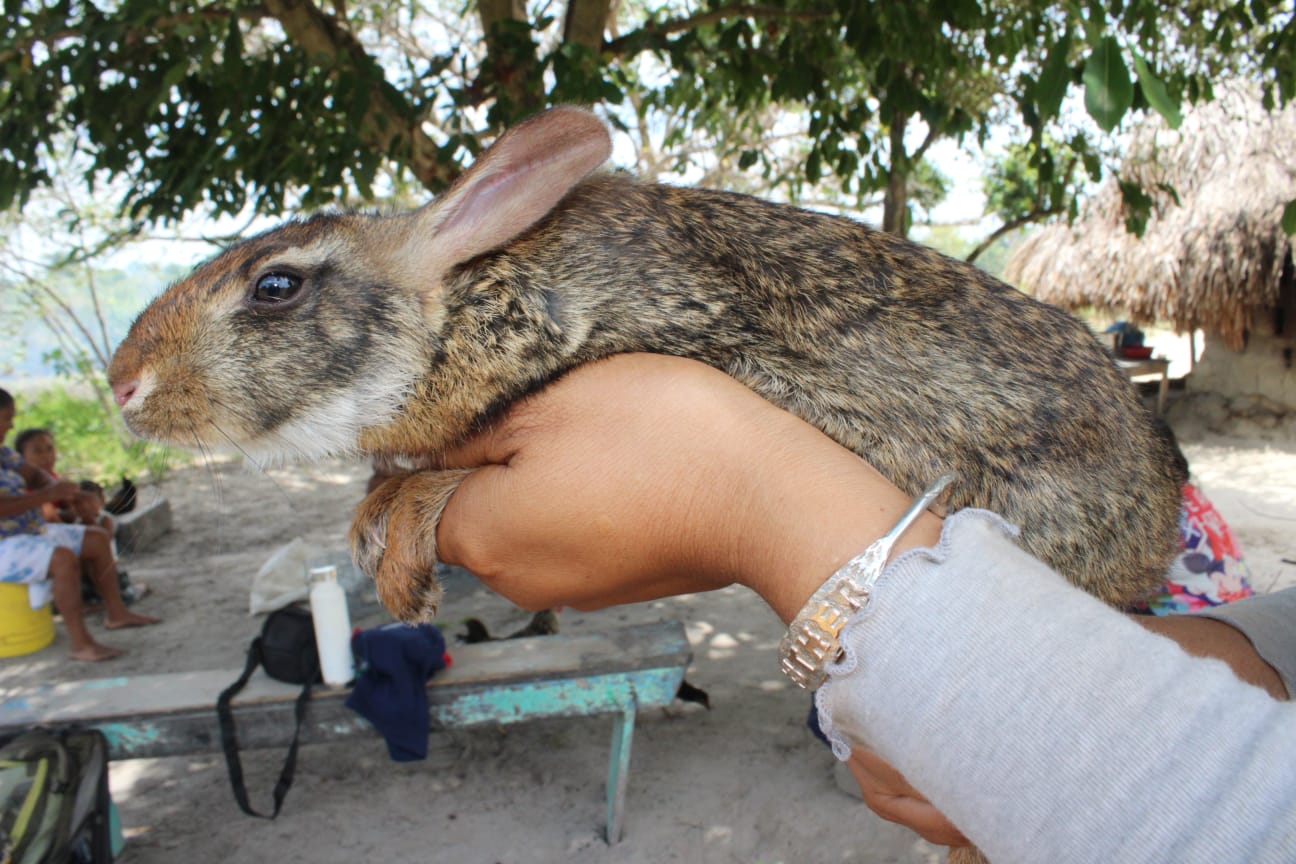
Международная команда совместно с представителями общины Караударнау подтвердила наличие вида Sylvilagus parentum в Гайане, что значительно расширяет известные границы его ареала. Это открытие, опубликованное в журнале Mammalia, подчеркивает важность интеграции традиционных знаний коренных народов с современными научными методами для сохранения биоразнообразия.
Перевод ИИ
Текст статьи доступен на языке оригинала.
Нажмите кнопку «Перевести статью» выше, чтобы сгенерировать перевод с помощью ИИ.
Оригинальный контент
Latest update August 28th, 2026 10:26 AM
Aug 26, 2026 News
(Kaieteur News) – The first scientific record of the cottontail rabbit “Sylvilagus parentum” has been confirmed in Guyana thanks to efforts by a collaborative team of Indigenous community members and international scientists.
Before this discovery, confirmed specimens had been collected only from western Suriname more than 40 years ago. The Guyana record therefore represents a major extension of the species’ known geographic range in South America and provides important new information on its distribution.
The discovery was published in the peer-reviewed scientific journal Mammalia, providing the first peer-reviewed scientific confirmation of Sylvilagus parentum in Guyana and making the discovery available to researchers worldwide.
“This discovery demonstrates the remarkable value of combining Indigenous knowledge with modern scientific research,” said Dr. Adam Ferguson, Negaunee Collection Manager of Mammals at the Field Museum. “The people of Karaudarnau have known this rabbit existed for generations. By working together, we have been able to document it scientifically and contribute important new knowledge about one of the Guiana Shield’s least-known mammals.”
In a statement, it was noted that while residents of the Wapichan community of Karaudarnau have known of the rabbit’s presence for generations, the species had never before been scientifically documented in Guyana.
The first scientific evidence came in 2020, when the Rupununi Wildlife Research Unit (RWRU), working through the Sustainable Wildlife Management (SWM) Programme, captured images of the rabbit on a camera trap in Karaudarnau Village, Region Nine. The photographs represented the first scientific record of a rabbit from Guyana but were insufficient to determine the animal’s identity.
Further evidence emerged during the preparation of the Mammals of the Rupununi field guide in 2021. Community discussions revealed that Karaudarnau was the only community in the Rupununi where residents consistently reported the presence of rabbits, reinforcing Indigenous knowledge that the species had long inhabited the area.
Community members also shared the Wapichan name for the rabbit, “Kazoo Tain”, highlighting the longstanding local knowledge of the species.
To determine the rabbit’s identity, researchers from the RWRU, the South Rupununi Conservation Society (SRCS), and Karaudarnau Village partnered with scientists from the Field Museum (USA) and the Royal Ontario Museum (Canada) in 2023 to collect four adult specimens for detailed scientific analysis.
At the time, the researchers did not know whether the rabbit represented an introduced species, an undescribed species, a previously unknown subspecies or a species already known to science. However, genetic analyses have now confirmed that the rabbit is Sylvilagus parentum, a species that was formally described only in 2017.
It was further stated that the confirmation of Sylvilagus parentum presence in Guyana raises questions about the species’ ecology, conservation status and distribution.
As such, researchers are now planning additional surveys to determine the rabbit’s full range within Guyana, estimate its population size, better understand its habitat requirements and ecology, and generate the information needed for an International Union for Conservation of Nature (IUCN) Red List assessment.
Despite being recognised as one of the world’s most biologically rich countries, Guyana continues to yield important scientific discoveries through ongoing research and partnerships with Indigenous communities.
The statement underscored that the confirmation of Sylvilagus parentum highlights how much remains to be learned about the country’s wildlife and reinforces Guyana’s position as a globally significant stronghold for biodiversity conservation.
Moreover, it was noted that the discovery also highlights the importance of long-term biodiversity monitoring and the critical role that Indigenous communities play in advancing scientific knowledge. Further, through the combination of local ecological knowledge with modern technologies such as camera trapping and genetic analysis, researchers continue to reveal previously undocumented aspects of Guyana’s extraordinary biodiversity.
Subscribe to get the latest posts sent to your email.
Aug 28, 2026
CPL – Saint Lucia Kings recorded back-to-back wins as they beat the Trinbago Knight Riders by 36-runs at the Queen’s Park Oval in the Republic Bank Caribbean Premier League (CPL). Tim Seifert...
Aug 23, 2026
By Sir Ronald Sanders (Kaieteur News) – I have been an advocate of the Caribbean Court of Justice from its conception. In 2015, on the Court’s tenth anniversary, I described its creation as arguably the most significant institutional achievement of the English-speaking Caribbean since the...
Freedom of speech is our core value at Kaieteur News. If the letter/e-mail you sent was not published, and you believe that its contents were not libellous, let us know, please contact us by phone or email.
Feel free to send us your comments and/or criticisms.
Contact: 624-6456; 225-8452; 225-8458; 225-8463; 225-8465; 225-8473 or 225-8491.
Or by Email: [email protected] / [email protected]
Аналитика ИИ и парсинга
Технические детали обнаружения, сопоставления и связывания статьи
Поисковый запрос
«Гайана кролик Sylvilagus parentum открытие»
Запрос, сгенерированный ИИ для поиска статьи в веб-источниках
Связанные результаты поиска
Открытие нового вида обычно означает, что ученые нашли прежде неизвестное животное. Но с лягушкой Pristimantis milpe все произошло гораздо необычнее: она была известна людям десятилетиями, просто все это время ее считали ...