Английский Культура
06.07.2026 Читать источник
Фильмы Брюса Коннера трансформируются в масштабные инсталляции для галерей
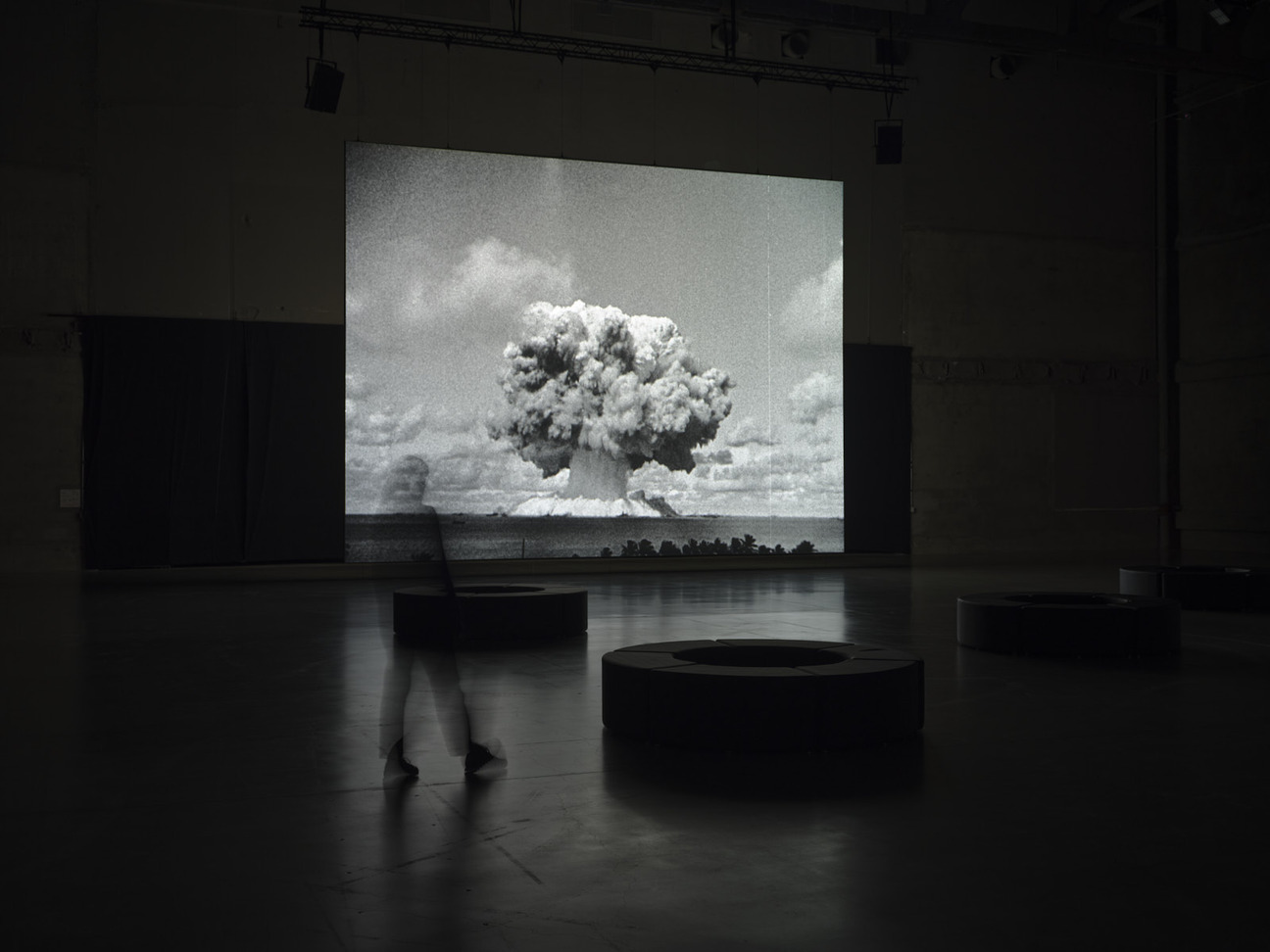
Эссе Вадима Ризова рассматривает, как перенос экспериментальных фильмов на большие экраны меняет восприятие искусства зрителями. Масштабные проекции, такие как «Crossroads», создают эффект погружения, превращая пассивное кинозрелище в активную галерейную инсталляцию.
Перевод ИИ
Текст статьи доступен на языке оригинала.
Нажмите кнопку «Перевести статью» выше, чтобы сгенерировать перевод с помощью ИИ.
Оригинальный контент
This week, Film Notes publishes an essay by Vadim Rizov that considers how Bruce Conner’s 16mm films have been reconceived as large-scale gallery installations. Drawing on his conversations with curator Douglas Fogle and Conner’s longtime collaborator Michelle Silva, Rizov asks what this migration between forms means for the artist’s audience and for the viewing experience of experimental film at large.
In 2018, the Los Angeles County Museum of Art opened “3D: Double Vision,” an extensive survey of the medium that included a room dedicated to exhibiting scenes from 3D films. When I visited, that space was packed with students on a high school field trip enjoying scenes from Avatar (2009) and Hugo (2011). But then came a snippet of Goodbye to Language (2014). As a man and woman spoke in dense Godardian maxims, an audible murmur of discontent rippled through the previously placid teens—a whispering sound that signaled, roughly, “What is this bullshit?” Before anyone had a chance to get really riled up came the film’s signature shot, in which two cameras switch sides, invigorating violence to the image and to spectators’ eyeballs. The energy immediately changed: Jean-Luc Godard had suddenly won over an entire group of teens he almost certainly never intended to reach. It was groundbreaking, hard art reaching unlikely converts, the kind of moment that could change a young person’s perception forever.
I thought about that heartening, unexpected instance of art breaking outside its usual reception spaces while visiting "Bruce Conner / Recording Angel," an exhibition at the Marciano Art Foundation in Los Angeles on view through July 18. Curated by Douglas Fogle, the show builds on the work done by the late artist’s assistant and editor Michelle Silva to preserve and re-present his films. Within the experimental film world, Conner’s legacy is set in stone, with Breakaway (1966) a brick-and-mortar work of the canon. Outside it, though, he lurks in the cultural marginality endemic to the medium. Working with this distinction in mind, the show re-presents Conner’s work in a way decidedly designed to win over audiences who might simply want to take in a high-profile museum show.
I was so impressed by “Recording Angel” that I came back to interview both Silva and Fogle a few days later. “He knew that the work would have its own life that was separate from his, and this made him very upset,” Silva said of the process of helping Conner begin to migrate his 16mm shorts onto new formats. The exhibition includes Three-Screen Ray, a re-edit of Conner’s Cosmic Ray (1961) that Silva helped reformat for triple-projection in 2006. A stroboscopic crowd-pleaser scored to Ray Charles, Three-Screen Ray is also Fogle’s preferred endpoint for the exhibition’s sequence, which begins with a super-sized Crossroads (1976), then moves backward in time before concluding with one of the first instances in which Conner transformed his work during his lifetime.
Crossroads is composed of footage from the 1946 Bikini Atoll nuclear test, a single explosion seen from twenty-seven different angles. Specifically, Conner utilizes footage of the “Baker” detonation—the world’s first underwater atomic blast, which displaced the atoll’s indigenous residents following the military’s never-fulfilled promise of a safe, eventual return. In the first half of Conner’s film, these explosions are scored by Patrick Gleeson’s synthesizer simulations of diegetic sounds, giving way in the second half to a lushly hypnotic Terry Riley score. The title has multiple potential meanings: as Warren Bass wrote in 1981, Crossroads could refer to “(1) ‘Operation Crossroads,’ the military code name for the specific 1946 test, (2) an ironic use of the Christian symbol, (3) a reflexive symbol of the film’s own structural crossroads or turning point, and ultimately (4) the crossroads for humanity the bomb has created.”
Within the context of the show, more meanings accrue to the title, including as a description of the program itself—a prime example of what Erika Balsom has described in Exhibiting Cinema in Contemporary Art as the “spectacularization of the museum,” enabled in part by the transformation of video art’s default means of presentation from monitors to higher-quality projections. Magnifying the work arguably makes it more aesthetically accessible, while the venue itself makes it literally more accessible: the Marciano is free to enter, making work that could once have been confined to screenings available to all for months on end and presenting it in a format maximally engaging for potentially unfamiliar audiences, a crossroads between arthouse and repertory cinema spaces and the broader cultural sphere. There’s a purist argument to be made against the decoupling of the work from its medium-specific origins, and it’s an argument I would theoretically be the first to make; the whole premise of the show initially filled me with unease. I entered as a Conner agnostic and exited, if not a convert, at least as an evangelist for this show.
When you enter, the first thing you see is a gigantic wall-size image of a nuclear mushroom cloud; depending on when you arrive, you might also hear the accompanying roar of the bomb itself. In the exhibition space proper, the back wall contains a gigantic screen reserved for Crossroads, with smaller screens on the left and right for shorter films. To close things out, viewers must turn back toward the entrance for a triple-screen projection of Three-Screen Ray.
In this format, the experience of Crossroads is overwhelming. The meticulously rendered digital image is not quite floor-to-ceiling but is still enormous. As someone used to seeing such work on the comparatively small screens of spaces dedicated to experimental film, it’s almost shocking. The sound is similarly massive and, in the first half, terrifying; it’s unpredictable when the explosion’s shockwave will hit the camera and make it shake with a gut-punch roar that, in this rendition, makes David Lynch’s bass-heaviest sounds seem comparatively restrained. In contrast to projections during Conner’s lifetime, when he was used to seeing people fall asleep during screenings, the film can’t be ignored.
Because those bomb sounds are actually Gleeson’s work rather than location sound, they were easy to render in eight channels that surround the viewer to simulate natural immersion. The second half overwhelms in a different, calmer way, with audio extrapolated from a long-lost two-inch master. OSHA regulations stipulate that in indoor settings, sound can’t be louder than eighty-five decibels; Crossroads, Fogle said, probably comes in at around eighty. “It’s probably still a little too loud,” he noted. “We may have to adjust it a little bit. But when we got really soft and brought it way down, it just disappeared because the room absorbs it.”
“Bruce was completely resistant to digitization for a very long time,” Fogle continues. When Conner finally committed to the process, he took his films back from longtime distributor Canyon Cinema, editioned them in runs of five, and began digitizing them as video projections destined for what Fogle calls “galleries turned into black box rooms.” Silva, who now manages Conner’s estate, knows what it cost him to let go of a process he could no longer fully supervise. “Grappling with the fact that you can’t micromanage everything from the grave was something that I know was difficult,” she says. Conner wanted the work to live and evolve, but for years video quality couldn’t match what he wanted. Once digital tools let him fix splices and control strobing effects himself, the appeal of authorship outweighed his loyalty to celluloid. “At the end of the day, he loved control more than he did film,” Silva says. “He called me up one day and said, ‘I declare myself a video maker.’”
The first digital projection of Crossroads took place from a DVD Conner made in 2002 at a show curated by Paul Virilio. “It was a big deal for Bruce to actually let it go and have it be a digital installation in a gallery space, and he insured that DVD for so much money that he actually didn’t get an artist fee,” Silva recalls. The installation that changed things for Conner, and Crossroads particularly, was at the Berlin Biennale in 2006. “All of a sudden, Crossroads was the most in-demand title for Bruce, which it never was,” Silva recalls. That was also the year he and Silva worked on Three-Screen Ray. “That was a huge departure for him,” she says, “because it was the first time he was using video as a creative tool. It still was film transferred, but he only used video for transferring his films before and now all of a sudden we were actually manipulating things with video.”
The only time Crossroads has been screened at a larger scale than it is at the Marciano was in 2018, in an abandoned church in Manila. Choices made for this presentation started with determining the screen size. “We could have gone even bigger, but we didn’t,” Fogle says. “Then we tested it out digitally to make sure it felt right proportionally.” The image isn’t masked, and, as he explains, “the other choice we made is to not back the screens with black felt, so there is a light that comes through and bounces a little off the back walls. To me, the minimality of it and making it not feel like a proscenium or going to a cinema as such, felt good. It felt more like an installation, yet it still presents as a film."
Аналитика ИИ и парсинга
Технические детали обнаружения, сопоставления и связывания статьи
Поисковый запрос
«Брюс Коннер 16 мм фильмы галерейные инсталляции перенос форматов опыт просмотра»
Запрос, сгенерированный ИИ для поиска статьи в веб-источниках
Связанные результаты поиска
Результаты поиска отсутствуют в БД
Парсер не сохранил результаты веб-поиска для этой статьи.