Английский Финансы
01.09.2026 Читать источник
FirstCry потеряла статус единорога: капитализация компании упала ниже миллиарда долларов
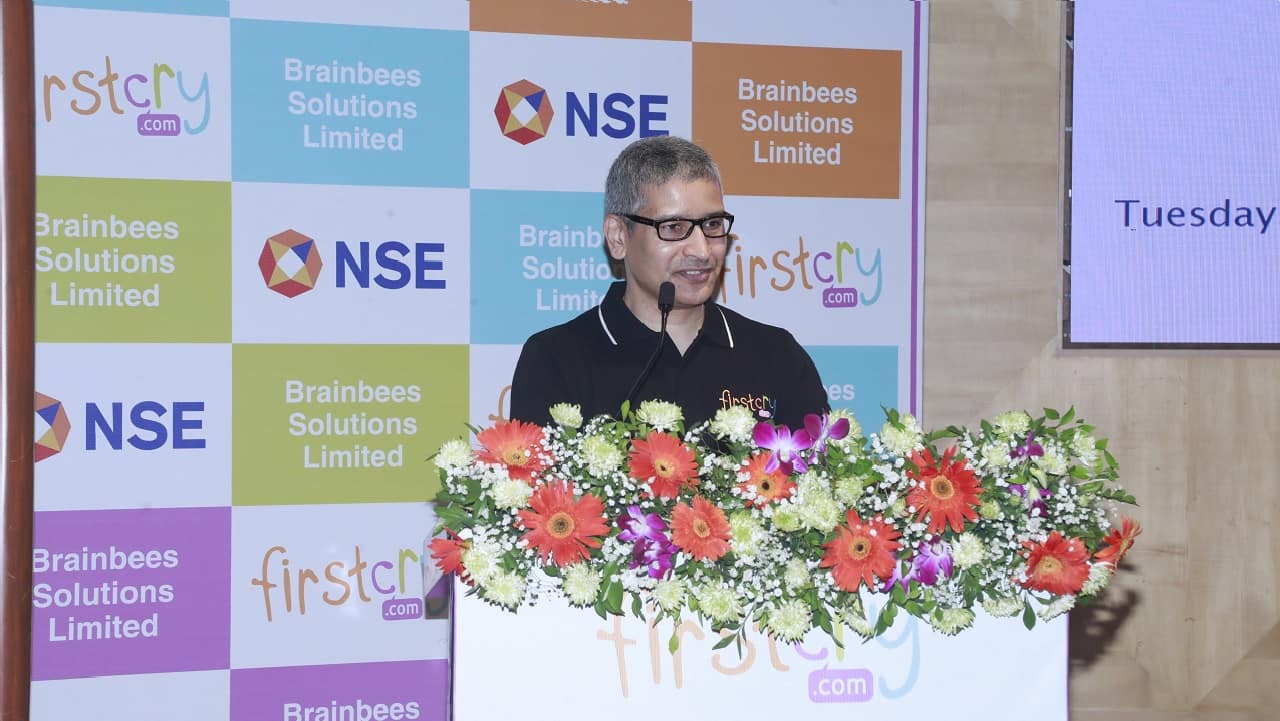
Рыночная стоимость индийского ритейлера FirstCry впервые с момента IPO снизилась ниже отметки в 1 миллиард долларов из-за замедления роста и усиления конкуренции. Основатель Supam Maheshwari признал, что компания не смогла вовремя адаптироваться к изменениям потребительского поведения и стратегическим вызовам на международном рынке.
Перевод ИИ
Текст статьи доступен на языке оригинала.
Нажмите кнопку «Перевести статью» выше, чтобы сгенерировать перевод с помощью ИИ.
Оригинальный контент
The man who once had three unicorns now has one less.
Supam Maheshwari, the founder behind FirstCry, GlobalBees and Xpressbees, saw one of his biggest bets lose its unicorn status on Monday.
Shares of Brainbees Solutions, the parent of FirstCry, fell 2.2 percent on August 31 to Rs 181.60, valuing the company at Rs 9,481 crore, or about $996 million on the BSE. It was the first time since its August 2024 listing that FirstCry's market capitalisation slipped below the $1 billion mark.
That is a remarkable reversal for a company that had once contemplated a $6 billion-plus listing and eventually went public at roughly $4 billion, significantly higher from around $2.7 billion at the time of announcing its price band.
From a peak valuation of around $4.5 billion, about $3 billion in market value has evaporated in a span of two years.
But the fall in valuation is only the symptom.
The bigger question is what happened to the company that once had almost every advantage in India's babycare market?
People close to the company and investors with exposure to the sector point to a combination of slower execution, a failure to keep pace with changing customer behaviour, a costly international expansion, a growing perception of FirstCry as a mass-market discount platform and a new generation of babycare companies that has moved faster.
Notably, FirstCry opted out of the quick commerce race, leaving the field wide open to a clutch of upstarts such as Ozi and Peeko in the rapid baby essentials delivery space
But, FirstCry is not sitting still now. Its latest annual report too acknowledges several of the pressures and shows the company attempting to course-correct.
But the question persists - are these changes too little, too late?
FirstCry built the rails. Others are now driving faster on it
The irony of the babycare quick-commerce boom is that FirstCry helped create it.
For more than a decade, FirstCry built warehouses, stores, supplier relationships, private labels, a large online catalogue and an omnichannel distribution network. It effectively laid down much of the infrastructure required to make babycare a scalable category.
The newer players are now using that foundation to build a different proposition.
Peeko, for instance, has grown nearly two-fold every quarter over the past six months, expanded its assortment to 27,000-30,000 SKUs and now offers a try-and-buy feature that lets parents inspect products at their doorstep before accepting them.
Chiratae Ventures, an early FirstCry backer, led Peeko's latest Rs 67.4 crore funding round.
Ozi, meanwhile, has raised successive rounds and now offers more than 15,000 baby and kids' products with 60-minute delivery.
One investor, with exposure to the baby quick commerce space, and tracks the sector closely put it bluntly: both Peeko and Ozi would have found it much harder to build this kind of traction if FirstCry had been executing with greater agility.
In fashion for instance, incumbents such as Myntra moved quickly with M-Now. Same is the case with Nykaa Now. In services, Urban Company continues to execute aggressively enough to make newer entrants like Snabbit and Pronto prove why they deserve to exist . Eternal owned Blinkit, previously Grofers, too adapted to the reality of quick commerce, making itself the undisputed leader.
In fact, in almost quick categories sans babycare, the incumbents are the market leaders.
The incumbent has the right to win – but it has to keep earning that right. FirstCry, investors say, has missed that bus so far.
FirstCry saw quick commerce coming – but not quite fast enough. The company’s own disclosures make this more uncomfortable.
In its FY26 annual report, the company called quick commerce “the single most disruptive force reshaping Indian e-commerce” and said it had materially reset customer expectations around delivery speed.
While people familiar said that was a key challenge, the problem was broader than delivery timelines.
Babycare quick commerce became a different way of shopping: curated selection, faster fulfilment, touch-and-feel and try-and-buy. FirstCry, despite having the scale and the customer base, did not move quickly enough to redefine its own proposition around those changing expectations.
That is why FirstCry has now launched Qwik and dramatically expanded RocketBees. The FY26 annual report goes further, describing dependence on third-party logistics as a “structural vulnerability” after customer-experience problems emerged.
The company's response : build more of its own delivery network, shorten turnaround times and make fulfilment part of the competitive moat.
By FY26, RocketBees had expanded to 62 cities, while Qwik was in five cities with deliveries in selected catchments in under three hours.
The company is now betting that this will help restore its edge.
The “why FirstCry?” question became harder
This is where FirstCry's problem may have gone beyond quick commerce.
People familiar with the business say the brand gradually became associated with everyday baby and kids' clothing and discounting. In India's top eight to 10 markets, FirstCry increasingly came to be seen as a value platform rather than a destination for premium or differentiated products.
That matters because the consumer is changing.
FirstCry itself now says Millennial and Gen Z parents are increasingly willing to pay for quality, safety-certified and trusted products. Its FY26 annual report explicitly talks about “premiumisation” and says its home brands are positioned to capture that trend.
People close to the company argue that FirstCry did not adapt quickly enough to that shift. A discount-led perception is difficult to shake once customers associate a platform with deals rather than discovery.
Perhaps the most revealing line in FirstCry's FY26 report is buried in the risk disclosures.
The company identifies “insufficient competitor monitoring”, limited use of data-driven insights and delays in product, personalisation and AI initiatives as risks that could restrict innovation and differentiation.
That is striking when read alongside what competitors have done.
FirstCry had the largest customer base, a huge catalogue and a decade-long head start. Yet it is now explicitly warning investors that not monitoring competitors sufficiently or moving slowly on product and technology could hurt differentiation.
That is almost a summary of the execution concern investors have been raising.
International was supposed to be the next big leg. It became a drag.
In its annual report in 2024-25, FirstCry had described the UAE and Saudi Arabia as a “strong white-space opportunity”, pointing to estimated per-child spending potential of 7-18 times India's. It said it planned to replicate its India playbook in KSA.
The economics have proved much harder.
For FY26, the company reports international revenue growth of 10 percent and says the loss fell by almost Rs 50 crore, from Rs 140 crore in FY25 to Rs 90 crore in FY26, with the adjusted EBITDA margin improving from 16 percent loss to 10 percent loss.
That is progress, but hardly the high-return global expansion investors were once being sold.
Management has also acknowledged elevated promotional pressure from horizontal e-commerce players in the Middle East.
And now FirstCry is cutting its planned Saudi capital allocation and seeking to redirect unused IPO proceeds, effectively moving from an expansion-first approach to a more cautious, unit-economics-led strategy.
People familiar with the company say the international expansion simply did not work as originally envisaged.
While it relooks its capital allocation strategy, top talent also became a challenge.
Show me the money
Two people familiar with the company operations said Maheshwari was not always the most aggressive paymaster when it came to retaining senior talent, making it harder at times to compete for top executives.
FirstCry's latest annual report doesn't directly confirm those claims. But it does flag “high employee attrition, limited talent retention, inadequate succession planning” and dependence on key personnel as risks that could cause operational disruption and leadership gaps.
The company is now talking about competitive reward frameworks, career development and deeper hiring across technology, AI, data science, digital products and logistics.
Again, the pattern is familiar: the problem is now recognised; the response is underway.
FirstCry still has a lot going for it
That is why this isn't a collapse story.
India's multi-channel business grew 9% in FY26, generated Rs 505 crore of adjusted EBITDA and remained free-cash-flow positive. Its annual transacting customer base rose to 11.03 million and gross merchandise value (GMV) reached nearly Rs 9,783 crore.
Home brands now account for more than 58% of India multi-channel GMV. GlobalBees is growing profitably. International losses are falling.
Money to be made
FirstCry’s investors, particularly the ones who came in late, haven't exactly made a killing, yet.
Sharrp Ventures entered FirstCry's pre-IPO secondary round at a valuation of around Rs 23,000 crore (then around $2.7 billion). With Brainbees now worth less than Rs 9,500 crore ($996 million), its investment is sitting at a steep mark-to-market discount, before accounting for any shares it may have sold.
Similar is the case with Premji Invest.
SoftBank's experience is better, but hardly spectacular by venture-capital standards. The Japanese investor has put roughly $400 million into FirstCry over multiple transactions and has already taken out around $450 million. It still owns a sizeable stake, worth roughly another $200 million at the current market value.
On those numbers, the investment has generated only a modest return over several years.
For a company once positioned as one of India's defining consumer-internet bets, that is hardly the outcome investors imagined.
Credit where due
And FirstCry deserves credit for something important: the new babycare challengers would not have had an addressable market this large without the ecosystem FirstCry spent years building.
The company created the distribution layer, educated consumers, brought brands online and built the supply chain.
What it failed to do, according to investors and people close to the business, was keep reinventing the proposition once that infrastructure became table stakes.
Now the company is trying to do exactly that – with faster delivery, a broader store proposition, deeper home brands, more technology and a more disciplined international strategy.
The question is whether the course correction has come early enough.
Because FirstCry's biggest problem may not have been that someone built a better babycare business.
It may be that FirstCry built the category so well that it forgot it still had to keep winning it.
Discover the latest Business News, Sensex, and Nifty updates. Obtain Personal Finance insights, tax queries, and expert opinions on Moneycontrol or download the Moneycontrol App to stay updated!
Find the best of Al News in one place, specially curated for you every weekend.
Stay on top of the latest tech trends and biggest startup news.
Аналитика ИИ и парсинга
Технические детали обнаружения, сопоставления и связывания статьи
Поисковый запрос
«FirstCry потеряла статус единорога капитализация упала»
Запрос, сгенерированный ИИ для поиска статьи в веб-источниках
Связанные результаты поиска
В четверг XRP торговался в узком диапазоне, поскольку трейдеры сосредоточились на сигналах внутри цепочки, предполагающих, что крупные держатели могут спокойно накапливать во время недавнего спада.