Английский Культура
06.09.2026 Читать источник
Мареk Яновски и Берлинский радиооркестр представляют наследие Ханса Вернера Хенце в новом альбоме
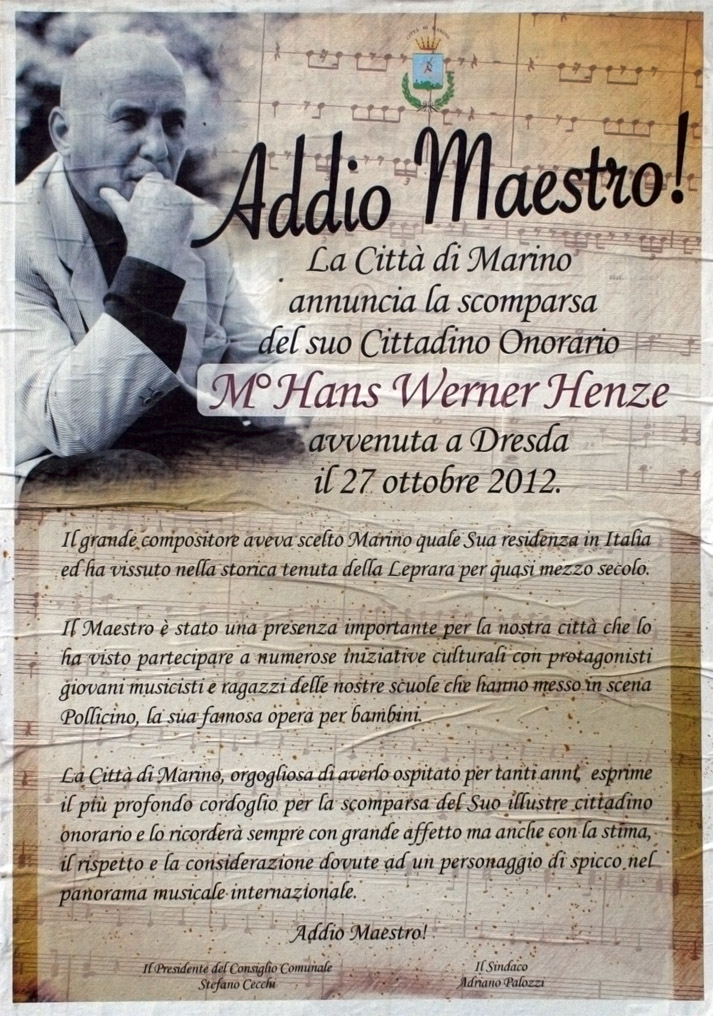
В рамках празднования столетия со дня рождения композитора вышел сборник всех его десяти симфоний, исполненных под управлением Марека Яновски. Критики отмечают, что этот альбом представляет собой последнюю великую немецкую симфоническую традицию, охватывающую периоды от послевоенного кризиса до поздних размышлений о нацистском прошлом.
Перевод ИИ
Текст статьи доступен на языке оригинала.
Нажмите кнопку «Перевести статью» выше, чтобы сгенерировать перевод с помощью ИИ.
Оригинальный контент
End of the road for the Great German Symphony
Album Of The Week
From the Lebrecht Album of the Week:
Hans Werner Henze: Sinfonia (Wergo)
****
The death of Philip Roth in 2018 was widely mourned as the end of the Great American Novel. Not of the literary novel itself but of the expectation that some day, somehow, a major writer will deliver the next revelation in a national saga. Since Roth, not much has troubled the keepers of tradition.
Much the same can be said of Hans Werner Henze, whose centenary is being observed this season with a spattering of German performances, and a few elsewhere. Henze was the last leading practitioner of the art of the German symphony. When he left Germany he redesignated his symphonies by the Italian name ‘sinfonia’. All ten of them are contained in this legacy box, performed by the Berlin radio orchestra under the baton of Marek Janowski.
They fall conveniently into three periods. The first five are a navigation through the post-War German morass, taking in the forms banned by the Nazis – the jazzy agitation of Kurt Weill’s Berlin and the austere serialism of Arnold Schoenberg and his school. Henze finds his own voice quickly, most attractively in the 20-minute fifth symphony, commissioned by Lenard Bernstein in 1962 for the New York Philharmonic at a time when that orchestra was at the forefront of discovery. The score is eloquent and engaging throughout. Not much hope now of a New York replay.
Henze left Germany in disgust at its intolerance of homosexuals and dissenters. His sixth symphony is a celebration of Fidel Castro’s Cuba, swaying with Caribbean rhythms and Hispanic rumbas. The seventh is his masterpiece, a conscious tribute to Beethoven and Mahler. The young Simon Rattle took up the seventh in 1980s Birmingham, finding a warm British reception
The ninth, written for the Berlin Philharmonic in 1997, deals, Henze said, ‘with the German homeland as it appeared to me as a young man (and… as) an expression of the greatest reverence for the people who resisted during the Nazi-fascist terror.’ Henze once told me that he stood in line of succession to Paul Hindemith, who was forced to leave Nazi Germany, and Karl Amadeus Hartmann, who went into silent inner exile. I would argue that he wrote the last Great German Symphony.
There is nothing trivial about Henze symphonies. I’m thrilled to hear them again, and in such precise and thoughtful readings as Janowski’s. As the nights shorten, you should try some.
NL
Read on here in The Critic.
Аналитика ИИ и парсинга
Технические детали обнаружения, сопоставления и связывания статьи
Поисковый запрос
«Мареk Яновски Берлинский радиооркестр Ханс Вернер Хенце альбом»
Запрос, сгенерированный ИИ для поиска статьи в веб-источниках
Связанные результаты поиска
Результаты поиска отсутствуют в БД
Парсер не сохранил результаты веб-поиска для этой статьи.