Английский Технологии
14.08.2026 Читать источник
Edelkrone представила бесшлейфовый моторизованный дolly Dolly GO для стабилизаторов
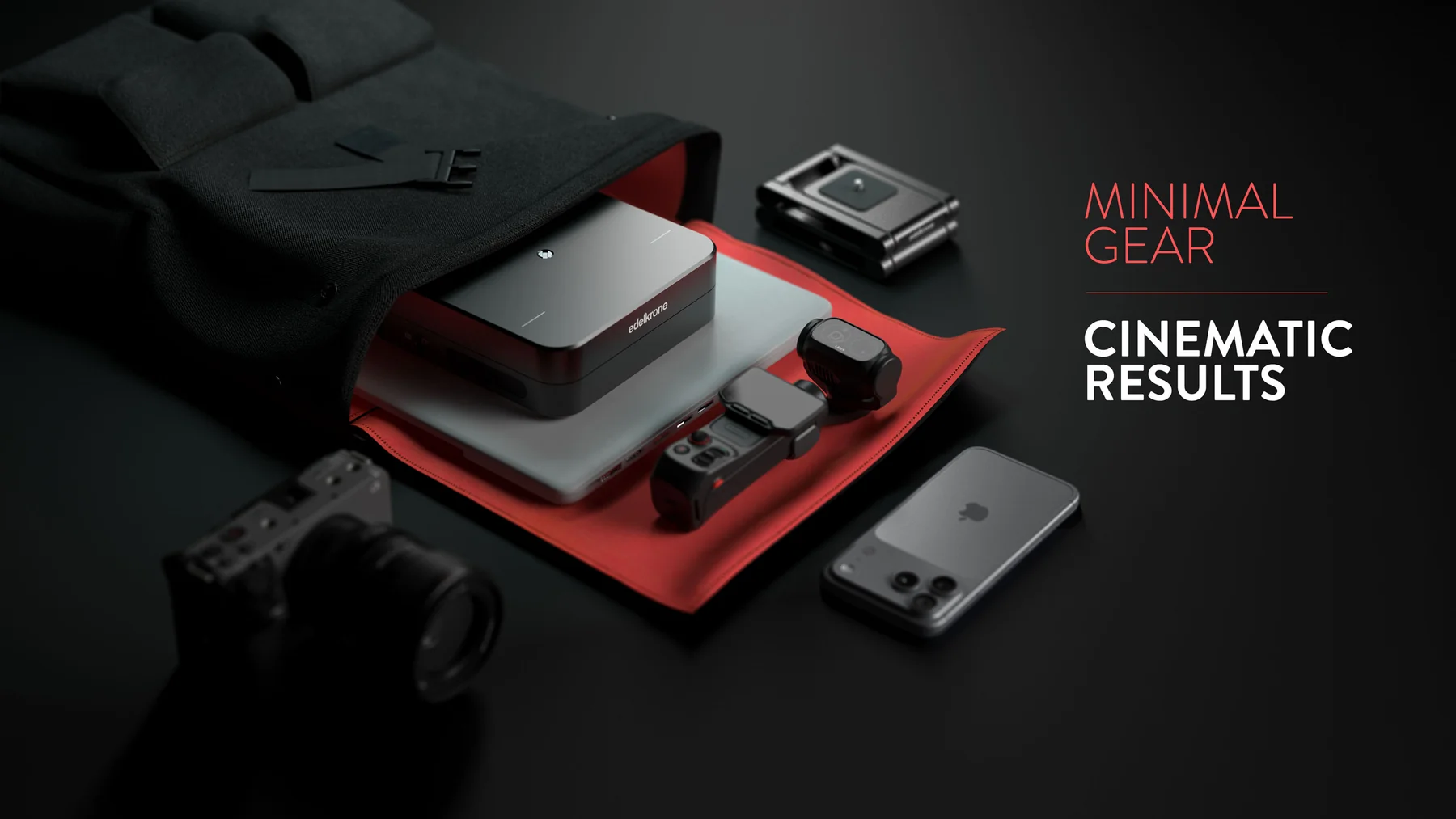
Компания Edelkrone выпустила устройство Dolly GO, позволяющее перемещать стабилизатор по заданным траекториям без рельсов и второго оператора. Новинка, доступная по ранней цене 359 долларов, предлагает альтернативу дорожным системам, используя шаговые моторы для обеспечения повторяемости движения на ровных поверхностях.
Перевод ИИ
Текст статьи доступен на языке оригинала.
Нажмите кнопку «Перевести статью» выше, чтобы сгенерировать перевод с помощью ИИ.
Оригинальный контент
Camera accessories maker edelkrone introduced the Dolly GO on August 12, 2026, a motorized dolly designed to move an existing gimbal through user-defined paths on any smooth, flat surface — with no rail, no track, and no second operator required. Available now at an early-adopter price of $359 (rising to a regular retail price of $399), the device undercuts the dominant alternative — motorized rail sliders with comparable repeatability, which routinely run $600 and above — by using a trackless stepper-motor architecture that trades mechanical path constraint for surface-dependent precision.
For the gimbal-owning solo creator, the Dolly GO addresses a specific gap: the gimbal handles subject framing and stabilization, but the camera still sits in one spot. Moving it has always required a second operator or a track system that is neither portable nor affordable for an independent creator. The Dolly GO is designed to be the third option.
Stepper-Motor Tracking: Repeatability Mechanism and Surface Constraints
The Dolly GO's core mechanism is a set of precision stepper motors — the same motor category used across edelkrone's full motion control lineup. Stepper motors divide a full rotation into hundreds of discrete angular steps, allowing the controller to track position by counting steps rather than relying on a continuous feedback sensor. The edelkrone system family publishes a step resolution of 0.022 degrees per step in its DollyONE stepper motor documentation, a figure that applies to the same motor class used in the Dolly GO.
When a user moves the Dolly GO by hand to a desired position and saves it via the edelkrone app, the controller records the step count required to reach that position from the dolly's starting point. Replaying the sequence reissues the same step commands, returning the dolly to within stepper-resolution accuracy of the original location.
The constraint this architecture imposes is equally specific: the positioning is only as accurate as the wheel-to-surface contact. On a perfectly smooth, flat, level surface — a production table, a polished concrete studio floor — each motor step corresponds to a fixed linear distance traveled, and repeatability is consistent. On a surface with texture, micro-incline, debris, or carpet, wheel slip and traction variation introduce positional error that accumulates across the move. edelkrone restricts use to smooth surfaces, specifically tabletop surfaces and smooth indoor floors, and notes that a "finalization" post-processing step is normally applied to motion control footage — a warp-stabilization pass that smooths residual micro-jitter that track geometry would have eliminated mechanically.
This is the trade the Dolly GO makes: it removes track from the equation entirely, which means it fits in a bag, deploys on a tabletop, and works anywhere a smooth flat surface exists — but the precision it delivers is stepper-encoder precision under ideal surface conditions, not the hard geometric constraint of a rail. For most solo creator applications (interviews, tutorials, product showcases, fitness content), this is more than sufficient. For high-precision VFX compositing requiring frame-accurate pixel alignment across multiple layered takes, a track system remains more reliable.
How Motion Chain Works in Practice
The Dolly GO ships with three movement types selectable in the edelkrone app: LINE, ARC, and FREE paths for slides, orbit shots, and custom curves. All three are created through the same hand-teach workflow — the user physically moves the dolly to each desired position and saves it; the Motion Chain feature strings those positions into a single smooth path with independently adjustable speed between steps.
Up to 12 positions can be stored in a single Motion Chain sequence. That is enough for a typical interview or tutorial setup to cover multiple framings — wide, medium, and close — without repositioning any gear by hand. The transition between positions is smooth enough to keep in the edit as a deliberate cut or transition rather than trimming it out as dead time.
The dolly pairs with any gimbal through the Gimbal Connector accessory, which costs $39 at early-adopter pricing, rising to $49 at regular price and sold separately. The connector is a physical mount bracket; the Dolly GO has no electronic connection to the gimbal's control system. It moves the entire gimbal rig as a unit along the defined path, while the gimbal's own subject-tracking software — whatever is native to the DJI RS series, DJI Osmo Pocket 4P, Insta360 Luna Ultra, or other compatible device — handles framing independently. The result is a two-system workflow: the Dolly GO moves the camera through space; the gimbal keeps the subject centered within that moving frame.
The effective entry cost for a creator who does not yet own the Gimbal Connector: $359 + $39 = $398 at early-adopter pricing.
Does It Work Without a Gimbal?
The Dolly GO works as a standalone camera mover without a gimbal attached. A camera mounted directly via a tripod head, FlexTILT adapter, or standard 1/4"-20 mount can execute LINE, ARC, and FREE motion paths on its own. This matters for table-top product photography (orbiting a product on a shelf), food and beverage content, real estate walkthroughs, and any situation where the camera is pointed at a stationary subject rather than a moving presenter. No framing adjustment is needed during the move because the subject is not moving.
The payload ceiling applies regardless of configuration: the total setup — camera body, lens, gimbal if used, and any accessories — must be under 2.3 kg (5.07 lb), with edelkrone's recommended limit for best results at 1.7 kg (3.75 lb). Most current mirrorless bodies with a standard prime lens fall comfortably under the 1.7 kg recommendation; adding a typical consumer gimbal like the DJI RS 4 Mini keeps the total near the recommended ceiling. Heavier professional cinema configurations — a Sony FX6, a cine prime, a large gimbal — exceed it.
What Pairs With It and Where Parallax Comes In
The edelkrone product page lists confirmed compatible devices across four categories:
Pocket gimbal cameras include the DJI Osmo Pocket 4P and Insta360 Luna Ultra. Smartphone gimbals include the DJI Osmo Mobile 8P. Camera gimbals include the DJI RS 4 Mini. For 360 work, the DJI Osmo 360 and Insta360 X5 are listed. Action cameras — DJI Osmo Action 6, GoPro HERO, Insta360 Ace Pro 2 — are compatible via direct mount or appropriate adapter.
The 360-camera pairing deserves specific mention because it unlocks a workflow that software alone cannot replicate. When the Dolly GO physically translates a 360 camera through space, the resulting footage contains real parallax — the apparent shift of near objects relative to far ones that occurs when the viewpoint itself moves through physical space. Software reframing of 360 footage (changing the virtual viewing angle in post-production) does not produce this effect; it simulates a pan or tilt but cannot simulate the perspective displacement of an actual camera moving through a room. The practical implication: a creator shooting with a 360 camera mounted on the Dolly GO can defer framing decisions until the edit, reframing and animating the shot in the camera's companion app — and the physical dolly movement will provide depth and spatial naturalism that virtual reframing cannot supply.
Power, Time-Lapse, and What to Budget
Power comes from dual Sony NP-F style batteries — a widely standardized form factor that many videographers already stock for other gear. The dual-slot design allows one battery to be swapped while the other powers the device, which matters for extended time-lapse shoots. Batteries are not included.
For time-lapse and stop-motion work, a built-in 2.5mm shutter trigger socket connects directly to the camera's shutter port; the dolly advances a defined distance between frames, adding camera movement to the time-lapse that a static tripod cannot provide. The shutter trigger cable is sold separately. The Dolly GO app is available for both Apple and Android devices.
The Dolly GO is the entry point in edelkrone's Motion Chain ecosystem, which scales up through the DollyONE v2 (a full-size trackless tripod dolly for larger camera setups and environments where the camera is farther from the creator) and the DollyPLUS v2 (which connects wirelessly to edelkrone pan-tilt heads for multi-axis motion). At the top of the lineup, the Krone X Compact bundle combines the DollyONE, JibONE, and HeadPLUS into a seven-axis backpack-ready robotic camera motion system. The Dolly GO is specifically designed for creators who already own a gimbal and want to add one dimension of automated movement — horizontal translation — without purchasing an entirely new tracking-head system.
At $359 early-adopter with a $39 Gimbal Connector, the all-in entry cost of $398 positions the Dolly GO as a compelling add-on for the majority of gimbal owners. Whether it stays compelling depends on how often those creators shoot on surfaces the stepper-motor system can use reliably — which is the question the product's flat-surface requirement will answer in the field.
Frequently Asked Questions
Does the edelkrone Dolly GO work with any gimbal?
It works with most gimbals, including DJI Osmo Pocket 4P, Insta360 Luna Ultra, DJI Osmo Mobile 8P, and DJI RS 4 Mini, among others. The connection is purely mechanical — the Gimbal Connector bracket (sold separately at $39 early-adopter / $49 regular) mounts the gimbal to the dolly platform. There is no electronic pairing or proprietary protocol required, which is why compatibility is broad. The only requirement is that the total setup — camera, lens, and gimbal combined — stays under 2.3 kg (5.07 lb), with best results at or below 1.7 kg (3.75 lb).
What surfaces does the Dolly GO work on, and why does it matter?
The Dolly GO requires a smooth, flat surface — a tabletop, a polished studio floor, a smooth countertop — to function as designed. It is not rated for carpet, uneven terrain, or rough outdoor surfaces. The reason is the stepper-motor positioning architecture: the device achieves repeatability by counting motor steps, which assumes each step translates to a fixed distance at the wheel. Wheel slip on textured or uneven surfaces introduces positioning error that accumulates across a move. Smooth surfaces eliminate the variable. For creators who shoot primarily in controlled indoor environments, this is rarely a limitation. For those who regularly shoot outdoors or on mixed terrain, a rail-based system offers more reliable repeatability regardless of surface.
What is the difference between the Dolly GO and the edelkrone DollyONE?
Both are trackless motorized dollies in edelkrone's Motion Chain ecosystem, but they serve different configurations. The Dolly GO is designed specifically for gimbal users — it moves the gimbal through space while the gimbal handles subject tracking. It is compact, bag-portable, and optimized for smaller camera payloads. The DollyONE v2 is a full-size tripod dolly that connects to edelkrone's motorized pan-tilt heads (HeadONE, HeadPLUS) for precise point tracking independent of a gimbal, supports heavier camera setups, and can expand into multi-axis Krone configurations. If you own a gimbal and want to add one axis of automated movement to it, the Dolly GO is the right entry point. If you want to build a full motion control rig around edelkrone heads, the DollyONE v2 is the foundation.
Can the Dolly GO be used for VFX compositing that requires layering multiple takes?
Yes, with caveats. The Dolly GO supports take layering through its position-repeat workflow: mark the starting position on the surface, return the dolly to that mark before each take, and run the same Motion Chain path. The stepper-motor system will reproduce the path to encoder-resolution accuracy, which is sufficient for most creative compositing uses — swapping objects, replacing backgrounds, blending subjects. For hard-edged compositing where pixel-accurate alignment is required across every frame, a track-constrained system provides more reliable geometric repeatability because the path is physically fixed rather than positionally recalled. The Dolly GO's approach is practical for creator-level VFX; it is not a substitute for a precision motion control rig in a visual effects studio context.
ⓒ 2026 TECHTIMES.com All rights reserved. Do not reproduce without permission.
Аналитика ИИ и парсинга
Технические детали обнаружения, сопоставления и связывания статьи
Поисковый запрос
«Edelkrone Dolly GO моторизованный дolly стабилизатор»
Запрос, сгенерированный ИИ для поиска статьи в веб-источниках
Связанные результаты поиска
Результаты поиска отсутствуют в БД
Парсер не сохранил результаты веб-поиска для этой статьи.