Английский Наука и Образование
03.09.2026 Читать источник
CS50 переходит к новому преподавателю и внедряет новый формат оценок
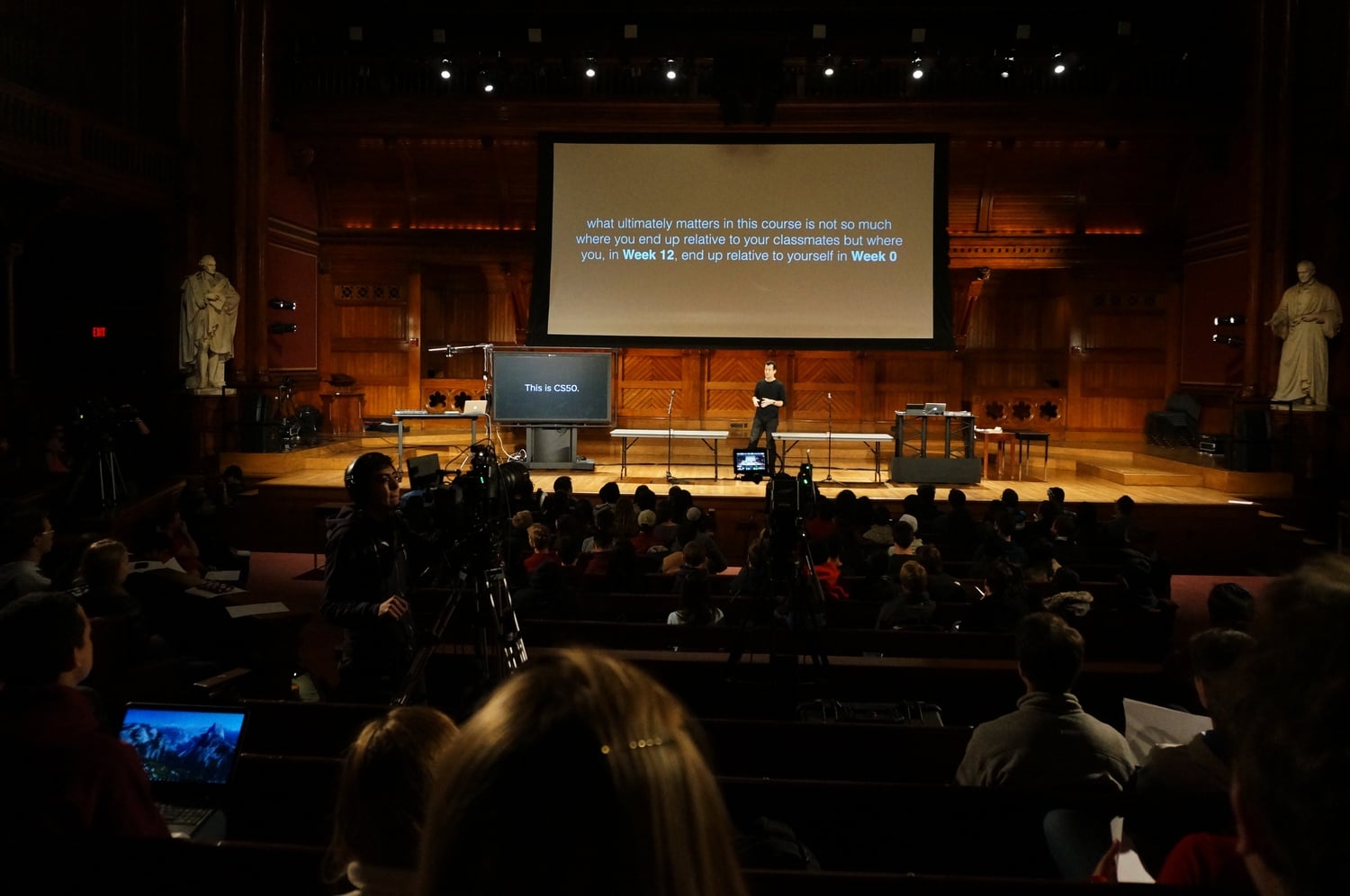
Курс CS50 в этом семестре возглавит лектор Генри Лайтнер, заменивший Давида Малана, который находится в академическом отпуске. В рамках реформы формат лекций изменится, а система оценки будет ограничена квотой на высшие баллы, начиная с 2027-2028 учебного года.
Перевод ИИ
Текст статьи доступен на языке оригинала.
Нажмите кнопку «Перевести статью» выше, чтобы сгенерировать перевод с помощью ИИ.
Оригинальный контент
CS50 Recompiles Amid Malan Sabbatical, New Grading Cap
For nearly 20 years, hundreds of students have filed into Sanders Theatre for Computer Science 50: “Introduction to Computer Science,” where David J. Malan ’99 has traditionally opened the course by stepping onto the stage, arms wide, and declaring, “This is CS50.”
But this fall, students taking one of the College’s flagship introductory-level courses will be greeted by a new face onstage — and a slate of changes to the course. Malan, who has taught CS50 every year since 2007, is on sabbatical, with computer science lecturer Henry H. Leitner taking over as the course changes its lecture format, assessments, and grading structure.
The course has long described itself as “for concentrators and non-concentrators alike, with or without prior programming experience,” sometimes attracting more than 800 undergraduates interested in learning about computer science or simply problem-solving.
Malan himself has famously said he entered the College planning to concentrate in government, with interests in history and constitutional law, before taking CS50 pass/fail during his sophomore fall — having had little exposure to computer science beforehand.
Over the years, CS50 has expanded beyond Harvard to the University of Oxford and Yale University, though the latter course was sunset after a decade amid financial challenges. CS50’s online version has reached roughly 7 million people worldwide.
Leitner began teaching the Harvard Extension School version of CS50 when Malan was still a senior at the College, when Leitner gave him the opportunity to teach the course and produce an online version filmed by his fellow undergraduates.
Leitner, who was among the rotating instructors who taught CS50 before Malan took over the course, will teach it while Malan is on sabbatical this fall.
The courses will place additional emphasis on in-person assessments and Python programming in response to the rise of artificial intelligence, according to Leitner.
Get The Crimson in your inbox.
Last fall, CS50 introduced a proctored midterm exam. This year, Leitner is expanding in-person assessments to three quizzes administered during lectures throughout the semester. CS50 has eliminated asynchronous quizzes and reduced the weight of problem sets from 60 percent to 35 percent.
Students will also be required to have 10-minute conversations with teaching fellows about a problem set’s key concepts — a response, Leitner said, to declining office hours attendance after the course introduced its own AI chatbot.
The changes come as the faculty voted overwhelmingly in May to approve a grading cap that will limit A grades at 20 percent, with the option of four additional A grades, beginning in the 2027-2028 school year.
In a June email, Dean of Undergraduate Education Amanda Claybaugh urged faculty to begin implementing the cap this fall, specifically noting that CS50 and several other introductory courses popular among freshmen had already agreed to abide by the cap this year.
According to a confidential grading dataset obtained by The Crimson, the share of A grades in CS50 remained relatively stable from 2014 to 2024, averaging roughly 35 percent, with notable drops to 27 percent and 16 percent during the 2022-23 academic year.
Last fall, roughly 23 percent of grades awarded in CS50 were A’s, according to the course’s website. The course also reports that another 35 percent of students took the course SAT/UNS.
Malan wrote in a statement that “CS50’s grade distribution is actually around the same already by design.”
He also confirmed that the course’s flagship events — including Puzzle Day and the Hackathon — will continue this year.
Students will attend lectures in Zimmer Hall B on Mondays and Wednesdays from 9 to 10:15 a.m., replacing the nearly three-hour long Monday afternoon lectures traditionally held in Sanders Theatre.
“A single two-hour-plus lecture once per week in Sanders can be challenging for a course whose material becomes increasingly dense and technical after the first few weeks, even with a break midway through the lecture,” Leitner wrote in a statement. “Meeting twice per week gives me an environment that I believe is better suited to sustained attention and learning.”
“The rigid wooden bench seating in Sanders is not particularly comfortable, and the seats provide no armrests or other convenient surface for students who are taking notes or working on laptops,” he added.
Leitner also said the Zimmer Hall B allows the course to record lectures remotely, rather than relying on the production team and cameras traditionally used to film CS50’s lectures in Sanders Theatre for its online programming — a consideration he said was particularly relevant given “financial changes facing the University.”
“Remote production can significantly reduce the amount of equipment and staffing that needs to be moved into classrooms, making lecture capture more efficient and potentially more cost-effective,” Leitner wrote. “So, ultimately, the move is about improving the student learning experience while taking advantage of new technology that can make course production more efficient.”
Tejas Billa ’28, who is returning as a teaching fellow after taking CS50 during his freshman fall, said the nearly three-hours sections — grouped by a student’s skill level — were his “favorite part” of the course.
“One of the best parts about that system for me was that I just got to pepper my TF with questions continuously about things I didn’t really understand that well,” said Billa, a Crimson Editorial editor.
Despite the changes, Billa said the teaching staff will “always prioritize getting students who are not familiar with CS over that finish line.”
“When I think about CS50, I think about a course that can take beginners, intermediates into programming and turn them into baseline full stack web developers and programming developers as well,” Billa said. “There’s so much energy that goes into the creation of this class.”
“I really think that it is the flagship course in our CS department to get integrated into not only compute the world of programming in general, but also if you were looking more specifically the world of computer science at Harvard,” he added.
—Staff writer Uy B. Pham can be reached at [email protected] or on Signal at ubp.88. Follow him on X @uybpham.
Want to keep up with breaking news? Subscribe to our email newsletter
Have a tip for The Crimson? Share it confidentially
Аналитика ИИ и парсинга
Технические детали обнаружения, сопоставления и связывания статьи
Поисковый запрос
«CS50 Генри Лайтнер Давид Малан новые оценки»
Запрос, сгенерированный ИИ для поиска статьи в веб-источниках
Связанные результаты поиска
Результаты поиска отсутствуют в БД
Парсер не сохранил результаты веб-поиска для этой статьи.