Английский Культура
02.09.2026 Читать источник
Выставка в Барбикане исследует Пан-Африку как воображаемую географию
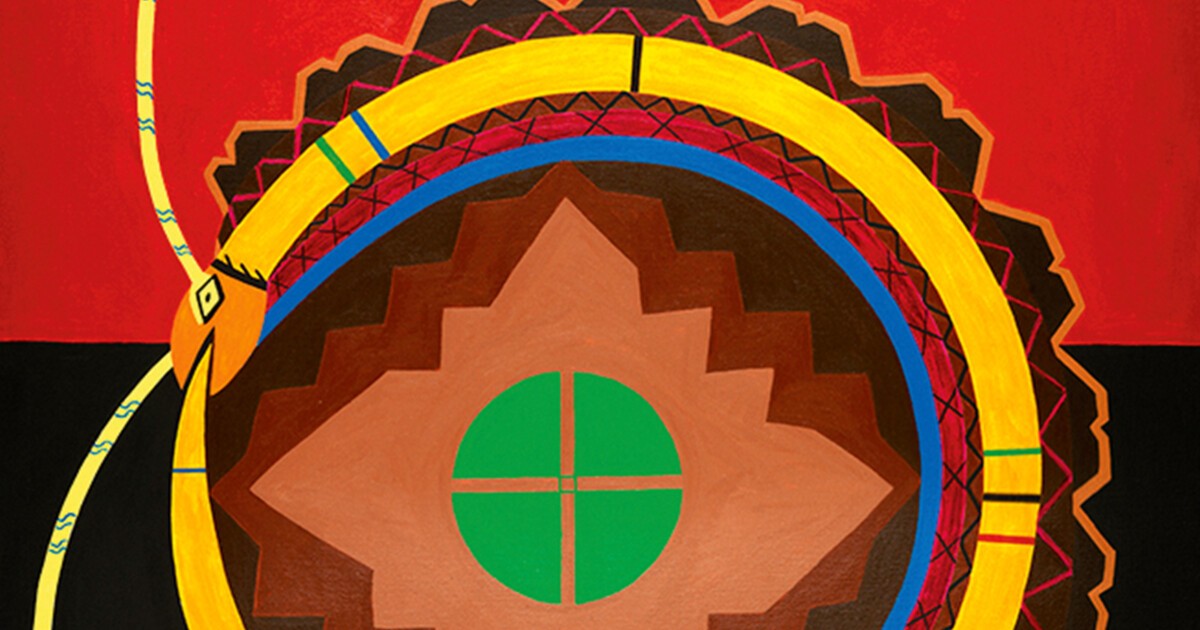
Выставка Project a Black Planet в Лондоне предлагает не историю движения, а интерпретацию Пан-Африки через призму искусства и воображаемой географии. Посетители могут оценить, как художники реагировали на идеи движения и его сложные отношения с расой.
Перевод ИИ
Текст статьи доступен на языке оригинала.
Нажмите кнопку «Перевести статью» выше, чтобы сгенерировать перевод с помощью ИИ.
Оригинальный контент
Project a Black Planet, the Barbican’s exhibition of the art and culture of Pan-Africa (until 6 September), doesn’t try to offer a history lesson. It is neither a comprehensive account of Pan-Africanism nor of the art associated with the movement; rather, the curators claim, the Pan-Africa explored here is an ‘imagined geography’. Early reviews of the exhibition’s London iteration (it has previously been shown at the Art Institute of Chicago and the Museu d’Art Contemporani de Barcelona) complained about its use of ‘dreary academic theory’, the amount of accompanying text and the many textual artefacts. But far from weighing it down, the inclusion of magazines, pamphlets and posters, and the opportunity to contextualise these via the wall texts, brings the ideas inspiring the many strains of Pan-Africanism to the fore. Viewers are invited to consider the way the artists on display responded to these ideas and how they navigated the movement’s uneasy and, at times, unstable relationship with race.
The show opens with two large flags hanging from the ceiling. David Hammons’s African American Flag (1990) hangs behind Chris Ofili’s Black British version; both recast symbols of empire and the nation-state in the colours of Pan-Africanism: red, black and green. In The Souls of Black Folk (1903), W.E.B. Du Bois wrote that ‘the problem of the 20th century is the problem of the colour line.’ Du Bois was referring not only to racism in the United States, but to ‘the relation of the darker to the lighter races of men in Asia and Africa, in America and the islands of the sea’. Several cartographic works included here take up Du Bois’s concept and subvert the division of the world into a developed, white northern hemisphere and an underdeveloped, dark southern hemisphere. Yto Barrada’s Tectonic Plate (2010), a wooden map with Africa at its centre, has moveable continents that can be slid closer to one another. And So What? (2009-10), by the Senegalese artist Abdoulaye Ndoye, looks at first glance like the map of a rocky coastline enclosing an inland sea; look again, however, and the outlines of land and sea appear instead to be the effects of fire and water on an ancient document whose faded calligraphic type is still almost legible.
Alongside postcolonial modernist stars such as Wifredo Lam are less familiar names. The Mozambican Italian painter and sculptor Bertina Lopes is represented by an oil painting, Mussunda, from 1961, which was completed at the beginning of the Angolan War of Independence. It was inspired by Agostinho Neto’s description, in the poem ‘Mussunda Amigo’, of an anti-colonial Angolan intellectual who, through writing in Portuguese, slowly becomes detached from his community. In Lopes’s painting, a Chokwe mask emerges from the dark background (Chokwe masks represent the connection between the material and the spirit world). Two figures, covering their faces with masks, are just visible behind it. Pieces of tangled string are stuck onto the canvas, perhaps to suggest that communication between the living and the dead is not always smooth. But the mask’s expression is calm and resolute; the message from the ancestors has been received and the task ahead is clear: independence.
The use of ‘Black’ in the exhibition’s title might suggest a narrow view of what constitutes Pan-Africanism, associating it too closely with essentialist conceptions of race. But Project a Black Planet handles themes of Blackness and Arab-African identity, for example, thoughtfully, selecting works that challenge the divide between Arab North Africa and Black (or sub-Saharan) Africa. The work of Ibrahim El-Salahi defies categorisation as either Arab or African, and makes use of motifs from European, Islamic, African and Arab art. In Self-Portrait of Suffering (1961) El-Salahi paints himself with loopy, spiral eyes and an open mouth, suggesting a state of bewilderment or uncertainty. The elongated face and stylised features are reminiscent of certain African sculptural traditions, such as Nok terracotta heads, but this is unquestionably a modern subject, albeit one with no stable identity. While the division between North and sub-Saharan Africa can seem insurmountable (due in part to racism faced by Black migrants in parts of the Maghreb), El-Salahi’s work is a reminder that Arab and African nationalism were once part of a shared anti-colonial politics. His homage to Patrice Lumumba, Funeral and the Crescent from 1963 (reproduced in the catalogue but not on display at the Barbican), shows a tiny, almost skeletal, Lumumba carried aloft by a group of emaciated mourners under the glare of a bloody crescent moon. El-Salahi’s use of Indigenous Sudanese and East African imagery, and its synthesis with Islamic art, suggests that Lumumba is mourned by all of Africa, regardless of identity, religion or nation.
There are some surprising moments in the exhibition. Simbiose Africana No. 3 (1973), an abstract painting by the Brazilian artist and writer Abdias do Nascimento, is placed next to Mohamed Melehi’s geometric Composition from 1976. Composition looks like a painting, but in fact Melehi used découpage, cutting out pieces of colourful cellulose fibre, gluing them onto a panel and sealing them with varnish to create a flat surface. In an essay published in the Journal of Black Studies in 1980, Nascimento pioneered the notion of quilombismo, ‘an Afro-Brazilian political alternative’, which drew inspiration from the maroon communities of escaped or freed enslaved people. These ‘viable free societies’, Nascimento wrote, offered a model that could be adapted to artmaking as well as politics. Quilombismo was a process of constant ‘revitalisation and remodernisation’ as well as a collective project in defiance of injustice and exploitation. Nascimento’s abstract paintings nod to the European tradition but are more deeply informed by Afro-Brazilian spiritual practices, just as Melehi’s work uses modernist techniques but draws on Amazigh art and architecture. The distinction between modernity and indigeneity is upended again and again throughout the exhibition.
The photographs borrowed from the collection of the Art Institute of Chicago are among the most intriguing works on display. Sanlé Sory’s photos of Burkinabé youth capture the sense of possibility in the aftermath of independence. One image shows a woman in front of a studio background of a plane: stylishly dressed in high-heeled boots and sunglasses, she appears to be embarking on a flight. Air travel might have been out of reach for many Burkinabés, but in the photographic studio the distinction between aspiration and reality doesn’t exist.
Rotimi Fani-Kayode’s Adebiyi (1989) could be one of Caravaggio’s beautiful young men, except that the topless youth is a Yoruba prince (‘Adebiyi’ means ‘of royal birth’) rather than an Italian street urchin. He stands poised, wearing a floral headpiece and delicately holding a Yoruba mask painted in red and black stripes; there is a fluidity to the gesture – he seems either to be taking it off or putting it on – but his eyes are lowered, their expression inscrutable. Perhaps this is Eshu, the Yoruba trickster god, who in one parable walks between two friends, wearing a hat that from one side appears black, from the other red. The two friends get into an argument over what colour the strange figure was wearing; only when they come to blows does Eshu reappear to reveal his chicanery. As KJ Abudu suggests, Fani-Kayode’s work is both a ‘re-enchantment of the photographic apparatus through Yoruba ritual’ and an unsettling of photography’s role in determining categories of race, gender and sexuality. The unsettling extends to the character of the work itself: the print is slightly fuzzy and there are large grey and white marks at the bottom – aspects of the gum bichromate process used to print the negative and which give it the quality of a painting.
Nicholas Hlobo’s Ndiyafuna (2006), a sculpture made from discarded materials, is exhibited in the same room. At first it appears to be a familiar urban scene: a figure bent over to rummage in a bin or bag of rubbish. But things aren’t so straightforward. Is the figure emerging from or entering the large black rubber sack? And is this a scene of desperation or titillation? The figure’s raised heels and low-slung jeans suggest something more provocative. The title translates as ‘I am looking’ or ‘I desire’; the figure appears to be doing both.
There are some excellent works from Black British artists spread across the gallery’s two floors. Claudette Johnson’s seemingly unfinished Figure with Raised Arms (2017) shows a man reclining with his hands folded behind his neck. The composition is closely cropped: the top of the man’s head and his elbows are cut off by the frame and his colourful checked shirt dominates the canvas (as in many of Johnson’s works, the figure remains monochrome). The man’s pose and gaze – he looks beyond the viewer, but seems to acknowledge them – suggest an unguarded familiarity. By contrast, Self-Study in Blue Oil Pastel (2024), composed of energetic blue lines, shows Johnson sitting but wary, ready to spring into movement at any moment. The exhibition also makes reference to Johnson’s feminist politics. Johnson and Ingrid Pollard, whose photographs for Maud Sulter’s book Passion: Discourses on Blackwomen’s Creativity (1990) are also on display, both worked at the Lenthall Road Workshop, a feminist printmaking collective based in East London that produced, among other things, T-shirts, pamphlets and protest posters. (‘As soon as we were in our boiler suits and masks, we looked like guerrilla fighters,’ Johnson recalled.)
Many of the works on show offer up a dream of the imagined Pan-African future. Abd al-Hadi al-Gazzar’s painting of two people dressed as astronauts, completed not long after the Egyptian revolution of 1952, claims outer space as the domain of the newly liberated nations of Africa. Dread Scott’s All-African People’s Community Passport (2024) imagines a world where the movement of people of African descent is no longer constrained by borders. (This desire for mobility is also reflected in the Afrodiasporic magazine Air Afrique, which evokes the name of a now defunct Pan-African airline to frame its cultural project.) Other works, such as the two paintings by Iba N’Diaye of a woman screaming, take on the violence and repression with which the movement was often met.
Project a Black Planet ends on an emphatic note. For the London show, the Barbican commissioned twelve new works from Lynette Yiadom-Boakye. One portrait (they are always of imagined people) shows a child, wearing only a T-shirt and white pants, crouching down in a bed of flowers. Two charcoal drawings – one of four women and one of four men huddled in conversation – invite deliberation. What are they discussing that we cannot hear? The drawing of the women is titled To Assume a Revolution (2026), which can be read more than one way. Are the women ‘assuming’ leadership of the revolution, or does the image represent the life that might be possible after a revolution? There are no neat answers here, but that’s the point. Pan-Africanism wasn’t coherent. The project isn’t finished. More important is that the viewer is given a role in assessing its past, and in imagining what forms it might take next.
Send Letters To:
The Editor
London Review of Books,
28 Little Russell Street
London, WC1A 2HN
[email protected]
Please include name, address, and a telephone number.
Аналитика ИИ и парсинга
Технические детали обнаружения, сопоставления и связывания статьи
Поисковый запрос
«выставка Барбикан Пан-Африка искусство воображаемая география»
Запрос, сгенерированный ИИ для поиска статьи в веб-источниках
Связанные результаты поиска
Вы познакомитесь со знаковыми экспонатами выставки, услышите их истории и узнаете о предназначении этих объектов.
Выставки по тематике «Культура, искусство, ремесло» Медиамузей 2026. 08.09.2026 - 12.09.2026. Фестиваль музейных коммуникаций. Место проведения: Россия, Нижний Новгород. Площадка: Академия Маяк имени А.Д. Сахарова. Тематика: Культура, искусство, ремесло. Фестиваль народных мастеров и художников России 2026. 10.09.2026 - 13.09.2026.