Английский Наука и Образование
06.07.2026 Читать источник
Радиомаяк отследил рекордный перелет малиновки через 350 миль за шесть с половиной часов
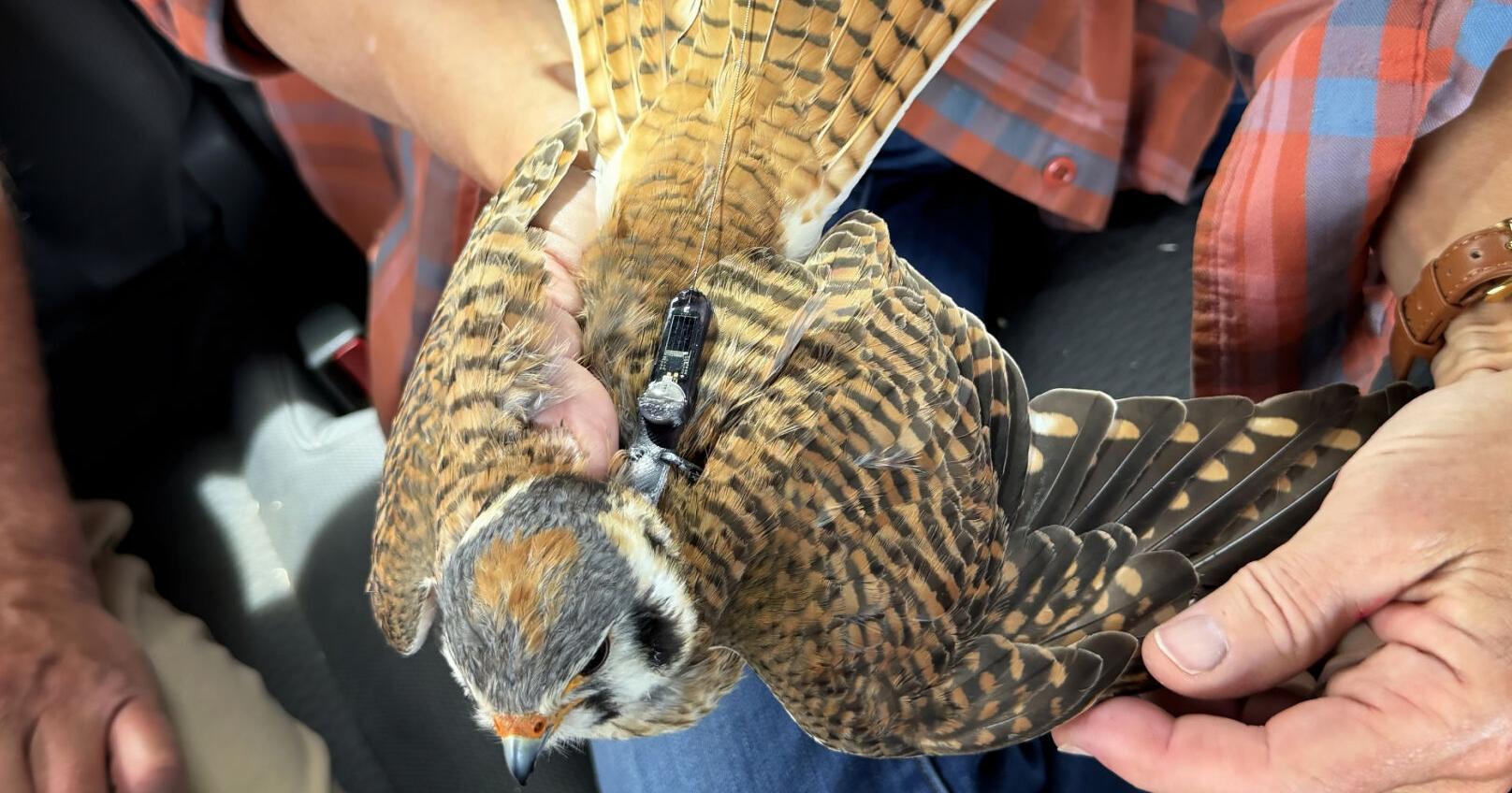
Сетевая система Motus зафиксировала полет малиновки Уилсона из Монтаны в Айдахо, преодолевшей 350 миль за 6,5 часов без участия наблюдателей. Ученые отмечают, что такие данные помогают выявлять миграционные пути и оценивать влияние загрязнения на популяции птиц.
Перевод ИИ
Текст статьи доступен на языке оригинала.
Нажмите кнопку «Перевести статью» выше, чтобы сгенерировать перевод с помощью ИИ.
Оригинальный контент
A Wilson’s phalarope took to the skies in north-central Montana in the early hours of June 21.
The small shorebird, tagged #71795, met the dawn over the Gallatin River near Bozeman. By 11 a.m., it passed Ririe in eastern Idaho — traveling 350 miles within six and a half hours.
No one saw #71795 make the journey. A network of radio towers recorded the frequency of the small solar-powered transmitter on its back.
In an interview with the Chronicle, Doug McSpadden pointed to a map on his computer screen, displaying the recorded points of the bird’s flight.
“This guy went from Freezeout Lake to the Gallatin River in three hours and 12 minutes; he averaged 68 kilometers an hour,” said McSpadden, president of Bozeman’s Sacajawea Audubon Society. “He kept going and got down to Idaho in three hours and 10 minutes averaging 62 kilometers an hour.”
Two days after #71795’s sprint to Idaho, the bird’s tracker pinged on the shores of the Great Salt Lake.
Wilson’s phalaropes winter as far as Tierra del Fuego in South America, but they breed in the interior wetlands of western North America.
While migrating north in the spring, they refuel at various sites, an activity known as staging. Hundreds of thousands of Wilson’s phalaropes stage at the Great Salt Lake before continuing north, per the Cornell Lab. It’s likely that #71795 — tagged in Freezeout Lake before its exodus — had just migrated north from the Great Salt Lake to breed.
So, why did #71795 turn tail and head south again in such a hurry? Was there a lack of food? Did it fail to find a mate? Did its nesting attempts fail?
These questions, McSpadden said, are lingering. People have long held incorrect assumptions about bird movement, but new tracking data like what #71795 has provided suggests migration patterns could be different than previously believed. This raises new questions about when, where and why birds travel.
The towers that recorded #71795’s journey are part of the Motus Wildlife Tracking System, an international network by Birds Canada of more than 2,400 radio receivers in 34 countries. More than 65,000 tagged birds, bats and insects are in the system, giving researchers a better understanding of flyways and habitat use for migratory and nomadic populations.
The tracking tags, which come in different sizes and can weigh as little as 1/200 of an ounce, are attached like small backpacks that typically fall off after nine to 15 months. Researchers equip birds with tags that are less than 3% of their body weight, according to biologist Kevin Ellison, Northern Great Plains program manager for the American Bird Conservancy.
The tags have not been shown to affect birds’ nesting, mating, flight patterns or travel distances, per the Sacajawea Audubon Society.
Motus uses automated telemetry, a radio frequency technology first developed in the 1960s. Each Motus tag emits a unique frequency of radio pulses that sensor stations pick up. #71795, for instance, rings in at 434 MHz.
Even though the technology behind Motus has been around for a while, the innovative aspect of the system is its collaborative nature, Ellison said.
“Basically, everybody used to do their own studies with their own tags, and if they had an automated telemetry system, it would be a frequency that they monopolized and worked on,” Ellison said. “(With Motus,) we’ve built a cooperative network so that everybody shares in the data collection, and shares data with each other.”
The shared information gives scientists a more complete view of how birds move between their breeding and wintering grounds. This allows researchers to determine survivorship rates across the full migration cycle and identify where certain populations are declining.
Motus and earlier tagging methods show birds that share breeding grounds do not necessarily winter in the same areas, per Ellison.
“Which I always say is biologically interesting, but kind of messy for conservation,” Ellison said. “It’d be really nice if we just had to save point A and point B, but in reality, we need to save point A and then points B through Z.”
In the Gallatin Valley, the Sacajawea Audubon Society, a local chapter of the national nonprofit, focuses on protecting birds and their habitats. It funds and maintains three Motus towers: one in Missouri Headwaters State Park, a second east of the Indreland Audubon Wetland Preserve and a third on the east side of the Flying D Ranch in Gallatin Gateway. A fourth tower is planned.
McSpadden said the goal is to cover local flyways, the routes birds are using to travel between breeding grounds and wintering locations. Each tower can detect a bird in a roughly nine-mile radius. In the Gallatin Valley, the towers are positioned far enough apart that coverage areas don’t overlap.
“What’s nice about Indreland is it covers the East Gallatin, and what’s nice about the Turner is it covers the West Gallatin, and then those obviously flow into the Missouri at Headwaters,” he said. “It’s nice to have that triangulation going.”
In the U.S., Motus exists via a patchwork of private and publicly funded projects, including federal and state grants, conservation nongovernmental organizations, and private donations.
In early 2025, Ellison asked if the SAS wanted to partner with the American Bird Conservancy and Montana Fish, Wildlife and Parks to fill the gap from Paradise Valley to the Jefferson River, which contains large flyways.
With SAS funding its own towers and tagging efforts, FWP can expand coverage into parts of the state that do not have the population or funding base to support the projects.
“There was basically a big gap from the Idaho border all the way to the Yellowstone River, and a lot of that gap has been filled now,” McSpadden said. “FWP is about to build a few more towers over in the Twin Bridges area, and that’s a really important flyway. They get a lot more birds than we do.”
Each tower costs more than $8,000 to erect, and Motus tags cost approximately $250 each. McSpadden expressed gratitude to the SAS funding contributors who helped fill these gaps in the network.
“All of those donations went directly to the construction and implementation of our programs, so we’re very thankful about that,” he said.
Ellison was the one who ordered the parts and assembled the SAS’ towers — first in his garage to test the systems, and then again in their monitoring locations.
“It’s kind of like a technology scavenger hunt,” he said.
Ellison made it clear that he doesn’t believe Motus is an end-all, as he’s constantly looking forward to whatever conservation tool comes next. For now, he sees Motus as having a lot of potential.
“As you get to the smaller species — it works on bats and butterflies and dragonflies and stuff — it’s really the only tool that works at the scale that we need for conservation,” he said. “It’s like looking at the system (of bird movement) through a pinhole camera, or a bunch of pinhole cameras, and trying to link together the stories.”
Even with the network’s low station density, Motus is providing scientists with new information about birds.
“My mantra is, the more we tag, the more we learn,” Ellison said. “That is true because every tag we’re putting out, we’re learning new things.”
One example is birds tagged west of the Continental Divide detected by Motus migrating east.
“That’s kind of mind-blowing,” Ellison said. “We kind of have what we call dogma-type beliefs in biology. So, then when you find out that animals aren’t following what we think the rules should be for migration, then we realize things could be much more fascinating.”
The SAS towers are already recording unexpected movement. Besides #71795, an American white pelican, tagged #68051, pinged at the Missouri Headwaters on June 5. #68051 was tagged in 2025 as a juvenile at Gunnison Island in the Great Salt Lake. It pinged at a dozen locations around the U.S, including central Iowa and coastal Texas.
McSpadden related the abundance of #68051’s tracking data to another one he photographed in the fall of 2020 in New Mexico. This bird bore a wing tag. When McSpadden reported the sighting, he learned it was the first time it was observed after being tagged nearly two years earlier.
Recent Motus data showed a thick-billed longspur, tagged #69953 in the New Mexico grasslands this spring, visiting the Missouri Headwaters. These chunky, sparrow-sized birds typically frequent the shortgrass prairies of central North America, but this is the westernmost detection of the species in the Motus network. These birds have experienced a 94% population loss during the past 50 years, according to the U.S. Fish and Wildlife Service.
More than one-third of U.S. bird species are of high or moderate conservation concern, including more than 100 species that have lost over half of their populations in the last half-century, per the National Audubon Society. The U.S. lost more than three billion birds since the 1970s — a quarter of the continent’s birdlife in half a human lifetime, according to the ABC.
“Those kinds of losses are dramatic and they’re worrisome,” McSpadden said. “The more we can find out about where birds are staging, how they’re flying, where they’re flying — it can help us hopefully rectify and mitigate those situations.”
Birds play a crucial role in ecosystems. Their relatively short lifespans and dependency on lower levels of food webs make them good indicators of environmental health, per Ellison.
For example, riparian birds like swallows, yellow warblers and vireos depend heavily on waterside insects. If pollution or pesticides impact those insect populations, bird populations also change.
“Birds are much easier to monitor because, basically, we can just show up on a day and count the birds that are singing there and over time look at an index of population decline in those bird species,” Ellison said.
He also pointed to the commercial value of birds for natural insect management.
“We have billions of agents of insect control that are working for free if we let them and encourage them, as opposed to spending tens of thousands of dollars on pesticides,” Ellison said.
For those still skeptical about why the everyday person should care about what happens to birds, Ellison referenced Emily Dickinson’ poem “Hope is a thing with feathers.”
“When you’re younger, you kind of feel like everything’s already been explored. People are focusing on the depths of the oceans and space,” Ellison said. “Then, as you learn more, you (realize) people don’t even know where this bird that comes here every year winters, or how it gets there. To me, that’s fascinating — that there’s still mysteries from our backyards we don’t know about.”
To track any of the birds mentioned in this story, visit https://motus.org/ and enter their tagging numbers in the search bar.
Аналитика ИИ и парсинга
Технические детали обнаружения, сопоставления и связывания статьи
Поисковый запрос
«отслеживание миграции фаларопы Уилсона в Монтане и Айдахо с помощью радиомаячков Motus»
Запрос, сгенерированный ИИ для поиска статьи в веб-источниках
Связанные результаты поиска
Результаты поиска отсутствуют в БД
Парсер не сохранил результаты веб-поиска для этой статьи.