Английский Медицина
02.09.2026 Читать источник
В Citrus County впервые провели процедуру чрескожной нефральной денервации для лечения устойчивой гипертонии
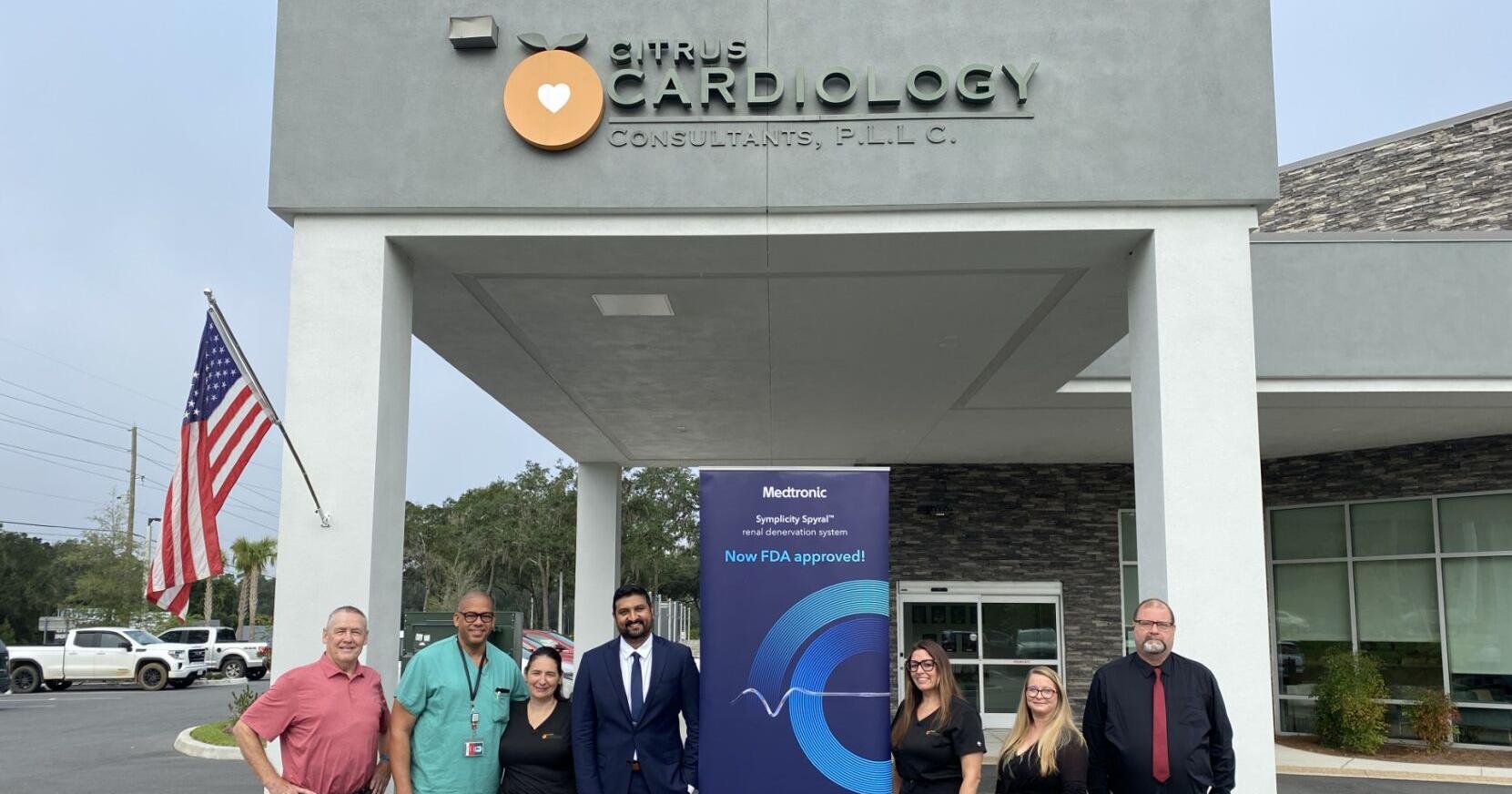
Врач-кардиолог доктор Мохиндер Виндхьял выполнил первую в округе Citrus минимально инвазивную операцию по денервации почек, что открывает новый метод лечения для пациентов с неконтролируемым высоким давлением. Данная процедура позволяет воздействовать на нервные окончания без разрезов и имплантатов, снижая потребность в приеме лекарств и уменьшая риски сердечно-сосудистых заболеваний.
Перевод ИИ
Текст статьи доступен на языке оригинала.
Нажмите кнопку «Перевести статью» выше, чтобы сгенерировать перевод с помощью ИИ.
Оригинальный контент
For years, patients with difficult-to-control high blood pressure have had relatively few options beyond adding more medications.
Now, Citrus County physicians have another tool.
The first renal denervation procedure in Citrus County was performed Monday, Aug. 24, at HCA Florida Citrus Hospital’s Heart and Vascular Center, marking the arrival of a minimally invasive treatment for selected patients whose blood pressure remains high despite medication.
Interventional cardiologist Dr. Mohinder Vindhyal performed the procedure.
The treatment uses a catheter to target nerves surrounding the arteries that supply blood to the kidneys. Those nerves play a role in regulating blood pressure. By delivering carefully controlled energy to the nerves, physicians seek to reduce excessive nerve signaling and, in turn, help lower blood pressure.
For local patients who qualify, Vindhyal said the procedure means advanced treatment is now available closer to home.
“We are able to do this, which is a minimally invasive catheter-based procedure, with no circular incision and no permanent implant,” Vindhyal said. “I think for appropriately selected patients, it gives them an option so that this therapy is available in our own place here and they don’t need to travel all day for them to get this done.”
The idea behind renal denervation is not entirely new.
In the 1930s through the 1950s, surgeons attempted to treat severe hypertension by performing radical open procedures called splanchnicectomies. The operations could lower blood pressure, but the side effects were significant. The approach was largely abandoned as effective blood pressure medications became available.
Decades later, researchers revisited the concept with a very different approach: Instead of surgically removing or disrupting nerves through open surgery, doctors could reach them with a catheter inserted through the blood vessels.
Early studies generated considerable interest in the 2000s, particularly as physicians began using radiofrequency energy to disrupt nerves around the renal arteries.
Then came a major setback.
In 2014, the SYMPLICITY HTN-3 trial, a rigorous U.S. study that compared renal denervation with a sham procedure, failed to meet its primary effectiveness goal. Development and research in the United States slowed dramatically.
Researchers subsequently identified problems that may have affected the earlier results, including medication adherence and incomplete treatment of the targeted nerves. Newer systems were developed, including catheters capable of treating multiple locations and systems using ultrasound energy.
The technology underwent additional clinical testing before the U.S. Food and Drug Administration approved the first commercial renal denervation systems in late 2023.
That approval moved renal denervation from an experimental treatment into an available option for appropriately selected patients.
The procedure is performed in a catheterization laboratory.
After medication is given to keep the patient comfortable, the physician makes a small puncture, typically in an artery in the groin, and guides a thin catheter through the blood vessels toward the arteries supplying the kidneys.
Once the catheter reaches the renal arteries, the physician positions the specialized device and delivers controlled energy through the artery wall. Depending on the system, that energy can be radiofrequency or ultrasound.
The goal is to affect the nerves surrounding the artery without blocking the artery itself or stopping blood flow to the kidney.
Once treatment is complete, the catheter is removed and the small access site is closed. There is no large surgical incision and nothing is permanently implanted in the kidney arteries.
Vindhyal said the treatment is particularly relevant in Citrus County, where an aging population means many residents are managing high blood pressure.
“Most of our patients have high blood pressure, and most of them have two or three blood pressure medications,” he said. “And in spite of that, the blood pressure remains high. This gives us one more therapy option.”
Renal denervation is not intended to replace blood pressure medication for everyone.
Patients considered for the procedure generally have blood pressure that remains above goal despite lifestyle changes and multiple medications, or they may have difficulty tolerating the medications needed to control their condition.
Doctors must evaluate each patient individually, including blood pressure readings, medications, kidney function and the anatomy of the arteries supplying the kidneys. Other causes of high blood pressure also need to be considered.
For patients already taking multiple medications, the hope is that renal denervation can improve blood pressure control and potentially reduce the number or doses of medications required.
But getting off medication is not guaranteed.
Vindhyal said some patients may eventually be able to reduce their medications, while others will continue to need them.
The importance of controlling blood pressure extends beyond the numbers recorded on a blood pressure cuff. Chronic hypertension increases the risk of heart attack, stroke, heart failure and kidney disease.
Vindhyal expects renal denervation to become more common as physicians gain experience with the technology and the population of patients with difficult-to-control hypertension grows.
“If we can take one risk factor away to help decrease the stroke and the heart attack and the heart failure, this procedure significantly helps decrease the blood pressure, thereby also decreasing the stroke, heart attack and heart failure,” he said.
For Vindhyal, however, the significance of the procedure is more immediate.
“My biggest thing is to let Citrus residents know that this is a new hypertension therapy, which we can get closer to home,” he said. “And to the appropriate patients so that they don’t need to travel anywhere to get this procedure.”
Аналитика ИИ и парсинга
Технические детали обнаружения, сопоставления и связывания статьи
Поисковый запрос
«чрескожная нефральная денервация гипертония Citrus County»
Запрос, сгенерированный ИИ для поиска статьи в веб-источниках
Связанные результаты поиска
Как проводится чрескожная пункционная нефростомия: Размеченный заранее участок кожи (а вместе с ним подкожную клетчатку, мышцы и ткани почки) прокалывают.
Перкутанная (чрескожная) нефролитотомия считается успешно завершенной, когда почка полностью очищена от камней, пациент чувствует себя хорошо, и не возникает осложнений.