Английский Общество
27.08.2026 Читать источник
Школа Санты-Фе внедряет инновационную программу по математике, чтобы догнать успехи в чтении
Дистрикт Санты-Фе стал одним из первых в штате Нью-Мексико, приняв масштабные реформы по математическому образованию, направленные на переход от механического заучивания формул к развитию критического мышления. Несмотря на скептицизм部分 учителей, администрация рассчитывает, что новая методика Inquiry-based поможет устранить пробелы в знаниях и повысить успеваемость учеников к следующему учебному году.
Перевод ИИ
Текст статьи доступен на языке оригинала.
Нажмите кнопку «Перевести статью» выше, чтобы сгенерировать перевод с помощью ИИ.
Оригинальный контент
As New Mexico takes steps to do for math education what it has done for reading, Santa Fe Public Schools is taking a leap.
The district is an early adopter of the state’s push to remake math instruction — an effort short of the reforms the state has mandated in reading, but one that still requires districts to overhaul their approach to math by the start of next school year.
The aim is to mirror the literacy playbook — in curriculum priority, in early testing for learning differences and, the state hopes, in the scores.
Across the state, 25% of students statewide tested at grade-level proficiency in math in 2024-25, versus 43% in reading. Santa Fe sits worse on both counts, at 22% and 41%.
Still, while reading scores have improved in the last few years — up 10 points statewide since 2022 — math scores have sat flat.
“I’m wary of anything that’s new. I just want to know what’s effective,” said George Ossorgin, who teaches fourth and fifth grade math and science at Piñon Elementary.
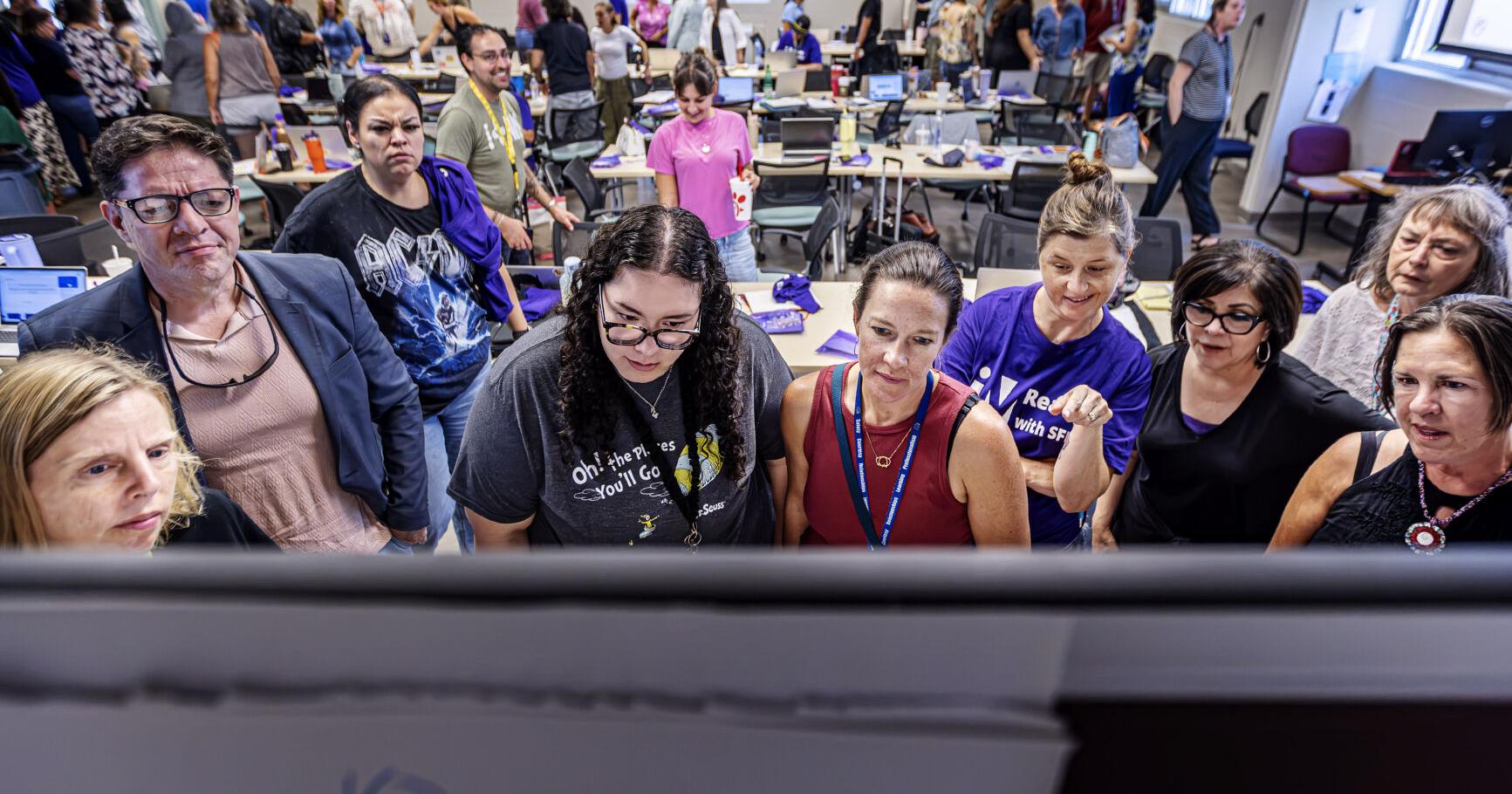
Ossorgin was one of some 400 math teachers across the district who took professional development courses this summer — the product of a yearlong exploration into improving its math program.
And he sees promise in the new curriculum, Illustrative Mathematics — described by fellow teachers as “turning math on its head.”
It’s an inquiry-based approach that begins with presenting students with math challenges rather than prescribing them the formula or algorithm to reach it — which could hint at the type of changes districts across the state will bring to their schools.
A new curriculum, as Ossorgin describes it, is like opening a restaurant.
“It’s going to come with a lot of headaches,” he said, stepping out of the professional development where he was trained on the new approach. “But this one might be a hit.”
Structured literacy for math?
State leaders hope to find success in a familiar playbook.
“Our long-term vision is we do need to focus on the content area of mathematics,” said Jacqueline Costales, executive manager of curriculum and instruction at the state Public Education Department. “Just like we did in literacy starting in 2019 with the passage of [Senate Bill] 398.”
That bill mandated universal dyslexia screening for first graders and sparked the state’s transition toward science-based reading instruction — the first of a slew of bills bringing the phonics-based structured literacy teaching into schools statewide.
But don’t expect to see such sweeping mandates toward a particular math pedagogy for school districts. Not yet, anyway.
“In mathematics, the research base is growing, [but] it’s not as comprehensive,” said Shafiq Chaudhary, senior manager of the department’s math and science bureau, comparing it with the 75-year evidence base behind structured literacy.
Still, decades of research offer lessons, among them an emphasis on building conceptual understanding for young learners — which the department baked into two optional programs for districts.
One of those programs is a math labs pilot, which died in the 2025 legislative session but which the department began to offer funds for anyway for K-6 classrooms to build those understandings and screen students’ numeracy skills. The other is NUMeROS, professional development for K-5 teachers with the same focus.
Santa Fe Public Schools uses both, with 15 teachers trained in NUMeROS and math labs in seven schools, according to the district’s STEM Coordinator Arturo Luján.
Both preview what will soon be mandatory under Senate Bill 29, passed this last legislative session by a bipartisan trio of sponsors including Sen. Bill Soules, a Las Cruces Democrat and former math teacher whose similar proposal the year prior died after approval in the state Senate.
Starting in 2027-28, schools must administer a math screener to every student in kindergarten through third grade.
Parents of students who show difficulties will be notified of areas of need, planned interventions and strategies to use at home. Keeping parents better informed, Costales said, was a lesson from the department’s structured literacy rollout.
Districts and charter schools must also implement math professional learning plans for teachers, and teachers-in-training licensed after July 1, 2028, will need six semester hours of “math methods” coursework.
The state Public Education Department department, for its part, must report annually to the governor and to the Legislative Education Study Committee on implementation beginning July 1, 2028.
Costales said the department is in “very good standing” to deliver on time — and, after the literacy work, “the field is primed.”
It is now gathering educator feedback on draft guidance to help schools prepare.
The guidance notes the screener is not meant to qualify students for Individualized Education Programs, nor to identify dyscalculia, a learning difference comparable to dyslexia but for numbers — an aim of an earlier version of the bill that “sort of muddied the water more than it needed to,” Costales said.
Instead, it will flag weaknesses in conceptual areas to help teachers personalize instruction.
New ‘math vision’
Santa Fe’s new direction came, primarily, from complaints.
Members of the district’s nascent math instructional group — formed to define the “high quality instructional materials” called for in Senate Bill 29 and earlier state math standards — met with school principals seeking recommendations, said Arturo Luján, STEM coordinator for the district.
The principals said students lack understanding of underlying concepts, and high school teachers often can’t teach grade-level material because students missed out on learning foundational skills years earlier.
Many teachers, Luján said, “rely heavily on the procedural aspect of mathematics — algorithms, formulas.”
“That would work in the primary grade levels, because they’re just following steps,” he added. “Everything goes well until they hit seventh and eighth grade. The gap just explodes in those grades.”
From there, principals, teachers and instructional coaches established “a district-wide math vision,” and an instructional group vetted models, settling on Illustrative Mathematics.
A runner-up checked almost all the boxes, Luján said, but most of its instruction required students to be on district-issued computers. Illustrative Mathematics “relies mostly on interactions between teachers and students” — and provides concrete objectives, and detailed guidance for moving students along learning progressions, for each lesson.
For Luján, a math teacher across district schools for years, Santa Fe’s commitment to the teaching model was long awaited. He earned a masters degree from New Mexico State University’s MC² program, a learning experience based in a conceptual model of teaching math he described as both a blessing and a curse.
“I couldn’t unsee it,” he said.
In crafting the model, the district partnered with the same NMSU MC² program that the state worked with to help shape Senate Bill 29, Luján noted, along with the Los Alamos National Laboratory Foundation and community partners such as Communities In Schools.
Special education teachers, too, will receive specialized training in the instruction.
“There has not been an implementation [of math curriculum] so robust in New Mexico before,” he said.
‘Routes in math’
At a training earlier this month, teachers put up and walked through a gallery of smart boards, each representing how a given grade of students would tackle a math problem — an exercise in how different ages approach math.
For Shari Cross, a second grade math teacher at Carlos Gilbert Elementary, the shift shows in the order of a lesson: students work individually, share with their classmates, and finally, the teacher synthesizes the material — a reversal of the usual approach that begins with the teacher’s lesson and formulas.
“It’s trying to take more of a student-led learning approach where the teachers are still guiding,” she said.
Rather than watching a teacher do problems, students “are actually having to actively think through” them before comparing approaches with peers, “seeing similarities and differences — and that there’s just a lot of routes in math.”
One routine, the number talk, has students solve an equation mentally — no pen or paper — signaling with a thumb to the chest, then sharing pathways while the teacher writes them down.
“If the kid didn’t get the correct answer, as they’re explaining it they usually catch it right away,” Cross said. “And then they’re like, ‘Oh, wait.’ ”
Superintendent Christine Griffin said the district wanted “that continuum of learning from kindergarten all the way through eighth grade.”
She acknowledged the approach, which mirrors the inquiry-based approach of is “extremely challenging for teachers,” who must lead children who think in all different ways through their own critical thinking rather than handing them the answer.
She expects it will take two to three years for teachers and students to master.
“I believe that we are in a time where it’s important that we are being really intentional about developing our teachers in their professional learning,” Griffin said, “and that we are also needing tools for developing students’ conceptual understanding, their ability to problem solve — to think critically.”
Аналитика ИИ и парсинга
Технические детали обнаружения, сопоставления и связывания статьи
Поисковый запрос
«школа Санты-Фе математика критическое мышление»
Запрос, сгенерированный ИИ для поиска статьи в веб-источниках
Связанные результаты поиска
Определение критического мышления: Во-первых, критическое мышление есть мышление самостоятельное. Во-вторых, информация является отправным, а отнюдь не конечным пунктом критического мышления. Знание создает ...
Уроки математики — отличная площадка для формирования критического мышления, поскольку математика требует логического анализа, решения проблем и построения аргументов.