Английский Наука и Образование
09.09.2026 Читать источник
В Гантерсвилле чествовали Жанетт Сиссим — первую чернокожую женщину-математика NASA, получившую ключи от города
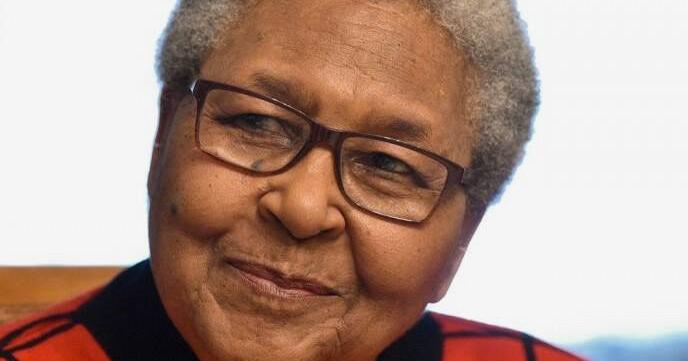
Город Гантерсвилл вручил ключи от города Жанетт Сиссим и её кузине Барбаре Джэн Антони за их выдающийся вклад в космическую программу США. Сиссим, работавшая в NASA с 1964 года, опубликовала важные исследования солнечных пятен и боролась за равенство в рабочем коллективе.
Перевод ИИ
Текст статьи доступен на языке оригинала.
Нажмите кнопку «Перевести статью» выше, чтобы сгенерировать перевод с помощью ИИ.
Оригинальный контент
Guntersville native becomes space program trailblazer
A NASA hidden figure has galactic roots in the Rocket City.
Jeanette Scissum, the first Black female mathematician hired by Wernher Von Braun in 1964, was recognized by the City of Guntersville at the end of August, during a celebration honoring her and her cousin’s, Barbara Jean Anthony, contributions made during their careers.
Each woman was presented a key to the city along with a resolution noting their achievements.
“I think my mother’s story offers hope; it’s always at the front of my mind. It’s an example that if you’re disciplined and hard-working, you can accomplish anything,” Scissum’s son, Willard, said.
Similar to Christine Darden, Katherine Goble Johnson, Dorothy Vaughn and Mary Jackson who were highlighted in the 2016 book, “Hidden Figures: The American Dream and the Untold Story of the Black Women Who Helped Win the Space Race,” Scissum had to “wield (her) intellects like a scythe, hacking away against the stubborn underbrush of low expectations,” as noted by the book. The book subsequently inspired a 2016 movie, “Hidden Figures.”
Scissum grew up in Guntersville, attending the only Black school in the area – Lakeview School. Her mother was a domestic worker, while her father was an Army veteran turned sharecropper. Her father, Jim, always told his daughter she was going to college.
Though she played basketball in high school, her parents made education her top priority. In 1956, when she graduated, she was one of the valedictorians. This led to her father’s prediction being correct.
“He recognized she was exceptionally smart even as a little girl. My mom is really quiet so, when she wasn’t playing with the other kids, she was helping my grandfather count the crops,” Willard said. “He noticed that she caught on really fast and out of all of her seven brothers and sisters, she was the only one that went to college. That’s not a put down on them, but my mom was the only one that they knew was going.”
Scissum attended Alabama A&M University with a work-study scholarship. While she studied mathematics, she spent her time as a switchboard operator to supplement her study.
During her time in college, she earned both a bachelor’s and master’s in mathematics from Alabama A&M University. Upon graduation, she took a teaching role at Councill Training School, Huntsville’s only Black high school in 1964.
“She loved to read. She’d go to the library – the section she was allowed in – and pick a book and sit and read. She’s told me she’s read the Bible at least seven or eight times all the way through. She wanted to be a missionary, so she studied religious things, but she also found herself interested in technology,” Willard said.
Then, her mother pushed her toward the chance of a lifetime.
When Jeanette found out about the Apollo program’s founding at NASA’s Marshall Space Flight Center, she pushed herself to be a part of it but didn’t know who to go to for an interview. Her mother worked in Guntersville for the hiring director for Marshall, taking one small step for her daughter to change space exploration.
“Your son really needs to hire my daughter,” Jeanette’s mother, Mattie Mae, said.
She went through a series of interviews and tests, which allowed her to take one giant leap for mankind. Von Braun sat in on her second interview and she got herself a new job.
In her newly appointed entry-level mathematician job, Scissum received various assignments that pushed the United States to win the Space Race. She studied to determine a landing site for the lunar module of the Apollo missions; she co-authored the code for these missions to land on the moon.
In her time at the space center, she also committed herself to other studies. In March 1967, she published a paper for NASA titled, “Survey of Solar Cycle Prediction Models.” This paper focused on sunspot cycles and how to improve techniques in their study.
Sunspots are spots on the sun that appear darker than the rest. They’re caused by fluctuations in magnetism that prohibit the transfer of heat to other areas. These spots appear in strong magnetic spots in the sun’s field in pairs that differ in polarity. “This is known as the birth of an active region,” Scissum wrote.
Scissum’s survey of other techniques proved to be a success, with the advancements of sunspot study being made today.
In her paper, Scissum said that an ideal approach to theorizing sunspot occurrence would be the creation of a new sunspot theory from previously existing ones. This theory would allow scientists to formulate proper mathematical predictions.
Today, we know that sunspots vary according to the sun’s 11-year solar cycle, with six sunspot regions that face Earth. The forecasting we use today comes from an adapted version of Scissum’s proposal.
She also was “humbled” to work as NASA’s Equal Opportunity Contact and fight for her co-workers to feel safer, receive tougher assignments and push for a more unified workplace. She still has thank-you notes from those she helped today.
After 13 years with the Marshall Space Flight Center, Scissum returned to Alabama A&M to study for a Ph.D. in computer science. When her final degree was awarded, she worked at the Goddard Space Flight Center, in Greenbelt, Maryland. She worked there until her retirement in 2005, completing 41 years with NASA.
In her free time, Scissum was more than a human computer. She was extremely family oriented. Willard explained that his mother and father didn’t leave room for them to question going to college. “(They) always said the only way you’re going to have a better life and change your circumstances is through an education.”
He explained that during the Easter holiday, everyone would gather at the TV to watch “The Ten Commandments,” and during the summer, the family would go on vacations and spend summer weekends at a church camp. “Those were our traditions.”
Willard and his siblings all went to college, or the military; Willard himself dreamed of being an NFL player, which he accomplished. He played for the Washington Redskins in 1987, the season they won Super Bowl XXII.
Jeanette took the time to chime in on her children’s accomplishments. “They always ask me who the favorite is, and I never have an answer. But I know you (Willard), have overcome so much in your life and it’s amazing to me, you never gave up.”
Jeanette, now 86, has lived a life that kids growing up in during the space race dreamed of. Today, unfortunately she has Parkinson’s and dementia, however, that didn’t stop her from recalling her favorite memories.
“She would sit with grandma, aunt Margret and Debbie (Willard’s sister), and eat neckbones and collard greens or pick stuff out of the garden. They would sit around the table and talk; she liked having her mother, sister and daughter all together,” Willard said.
“I used to love that,” Jeanette said.
Willard added, “The example she forged for a lot of Black women and young people in general that may not have come from big schools or advantaged backgrounds is that you just have to stick with it. My parents always told us, ‘People have accomplished a lot more with a lot less.’ And that’s one of the things we tell our nieces and nephews – my mother’s grandchildren – today. If you look at your grandparents and what they accomplished and the disadvantage they came from, you have no excuse.”
Аналитика ИИ и парсинга
Технические детали обнаружения, сопоставления и связывания статьи
Поисковый запрос
«Гантерсвилл ключи города Жанетт Сиссим NASA»
Запрос, сгенерированный ИИ для поиска статьи в веб-источниках
Связанные результаты поиска
Результаты поиска отсутствуют в БД
Парсер не сохранил результаты веб-поиска для этой статьи.