Английский Прочее
04.09.2026 Читать источник
Любитель острого из Оуэнсборо запустил бизнес по продаже домашнего перца и джемов
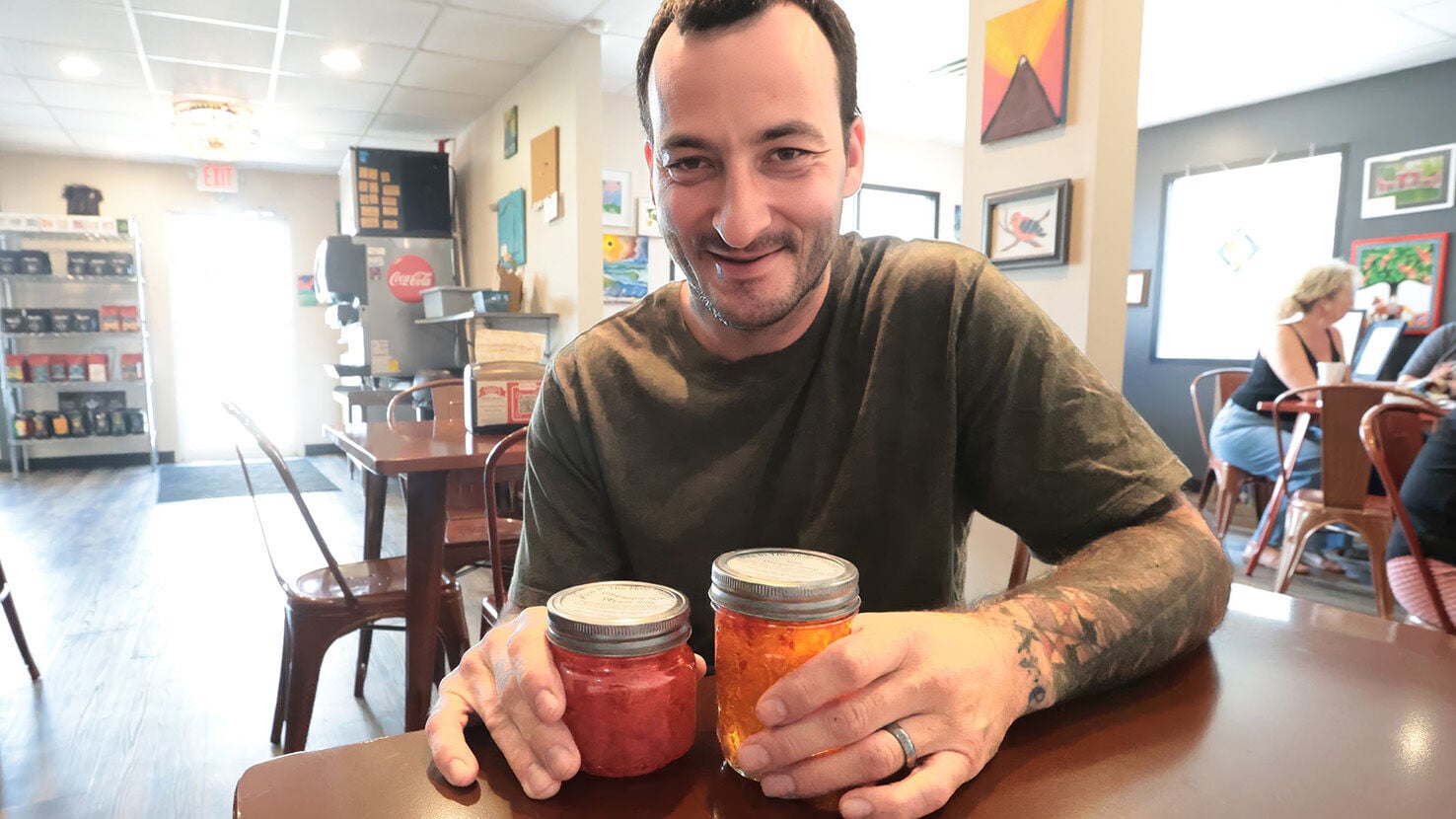
Кейб Чэпман, увлеченный выращиванием экстремально острых перцев, начал производить и продавать джемы и засахаренный перец через свой бренд Fire in the Hole Pepper Co. Продукция, созданная в домашних условиях, уже доступна в местной пекарне и через социальные сети, а предприниматель планирует в будущем получить коммерческую лицензию для выхода в розничную сеть.
Перевод ИИ
Текст статьи доступен на языке оригинала.
Нажмите кнопку «Перевести статью» выше, чтобы сгенерировать перевод с помощью ИИ.
Оригинальный контент
Owensboro’s Caleb Chapman fell in love with hot peppers after being introduced to them by a Vietnamese friend.
“He introduced me to Thai food. ...So, I tried it on the spiciest level you can get, and I kind of fell in love with the hot peppers,” Chapman said.
Peppers, he explained, are rated using the Scoville scale, which measures the amount of capsaicin in a pepper. Capsaicin is what makes peppers hot. For example, a bell pepper measures zero Scoville heat units, while a jalapeño measures 2,500 to 8,000 Scoville heat units.
His love of spicy food and, subsequently, hot peppers led Chapman to start his own crop of peppers, which, he said, often range from 500,000 to 1 million Scoville heat units. For comparison, a habanero measures between 100,000 and 350,000 Scoville heat units, and the Carolina Reaper, one of the world’s hottest peppers, can reach between 1.2 million and 2.2 million Scoville heat units.
“There’s some rare varieties that you can’t find in stores. You have to buy seeds from somebody, a seed dealer, who sells them...and that’s why I think my peppers are unique because you can’t buy them in stores,” he said.
He starts the pepper plants inside his home sometime in late January or early February.
“I start them in small cups, and once they get a couple inches tall, I move them to like a four inch cup...and then in May, after the first frost, that’s when I get them outside, about the same time that other crops are planted,” said Chapman. “Hot peppers have a long growing season. ...It’s almost like the hotter they are, the longer they take.”
In past growing seasons, he said, he has planted upward of 60 pepper plants for the season.
“My whole backyard was basically planted. And it was like it was almost too much...It was a lot. I went overboard,” he laughed. “I was basically giving them away at that point, and it’s hard to give away hot peppers.”
Each plant, he said, can produce upward of 200 peppers in a season.
“Next year, I’m probably going to go eight — four sweet peppers, four hot peppers. I used to have...like 12 different varieties of the hot peppers, and I would see those in different bowls at the market for people to have different choices, and it’s kind of interesting for people to find (new) peppers because there’s literally thousands of varieties of hot peppers,” he said.
And it was that abundance of peppers that led Chapman to think about what he could do with the leftovers, other than drying them and using them in recipes.
“I wondered what it would be like to get into canning and making some jellies and stuff like that,” he said.
He started working on his recipe, taste-testing batches of hot pepper jelly until he settled on several varieties: original, pineapple and blueberry, along with canned candied jalapeños. He does all of the canning in small batches out of his house, which, he admitted, is a time-consuming process and also a “labor of love.”
He said Kentucky requires a Home-Based Microprocessor (HBM) certification for this type of food-making venture.
“It’s a very long process, and it takes a lot of work,” he said. “You gotta get your microprocessors license...so you can do like just general home goods and stuff like that. ...You basically have your recipe and you put your ingredients together on the stove.”
He said he can usually get around six jars for each batch of jelly.
“To do like 40 or 50 jellies, it’s like nine to 10 hours of work, and you’re standing up. And to do canning, you’re on a timer — every process of the way is timed, and you have to be pretty consistent with it,” said Chapman.
His first customers were friends and family, but the canned pepper jellies went over so well that he decided to start selling some through a business named Fire in the Hole Pepper Co. He currently sells the jellies and candied jalapeños at Niko’s Bakery & Cafe, located at 601 Emery Drive in Wesleyan Park Plaza, and through social media, including the business’s Facebook page of the same name.
“Whenever I first heard about pepper jelly, I was like...it sounds kind of nasty. But it’s super good. It’s really great for holidays or get togethers,” he said.
He suggests eating the jelly as a dip combined with cream cheese.
“You just take a block of cream cheese and you pour it on there, and everybody loves it. You can smash an entire jar in a day,” Chapman said.
He said the jellies also work well in sauces and as a glaze, adding that he had used one of the jellies as a glaze on a smoked ham.
As far as the future goes, Chapman said he would like to get a commercial license so he can get the pepper jelly into stores one day.
“To be able to maybe sell them at stores...I think that would be pretty cool. Maybe sell them online...I never did this to make money — I started doing it because I love peppers. It’s not like I could quit my 9-to-5 to do it, but I just love that people love it because I never meant for it to be a business. It literally just started by me just enjoying hot peppers and growing hot peppers, and it was just kind of like a whim,” Chapman said.
Аналитика ИИ и парсинга
Технические детали обнаружения, сопоставления и связывания статьи
Поисковый запрос
«Кейб Чэпман Оуэнсборо острый перец джемы бизнес»
Запрос, сгенерированный ИИ для поиска статьи в веб-источниках
Связанные результаты поиска
Наш смелый викинг решает проверить свои силы, дегустируя один из самых острых перцев в мире — Carolina Reaper. 💥 Сможет ли он справиться с огненным вкусом и не потерять лицо? 😱 Не пропустите...
Естественно, быстрое развитие окраин не означало, что центр города прекратил меняться. В центре была построена площадь Сергельсторг, на которой расположились 5 башен бизнес-центров.