Английский Общество
27.08.2026 Читать источник
Пешехор из Орландо прошел тысячи миль по США ради благотворительности
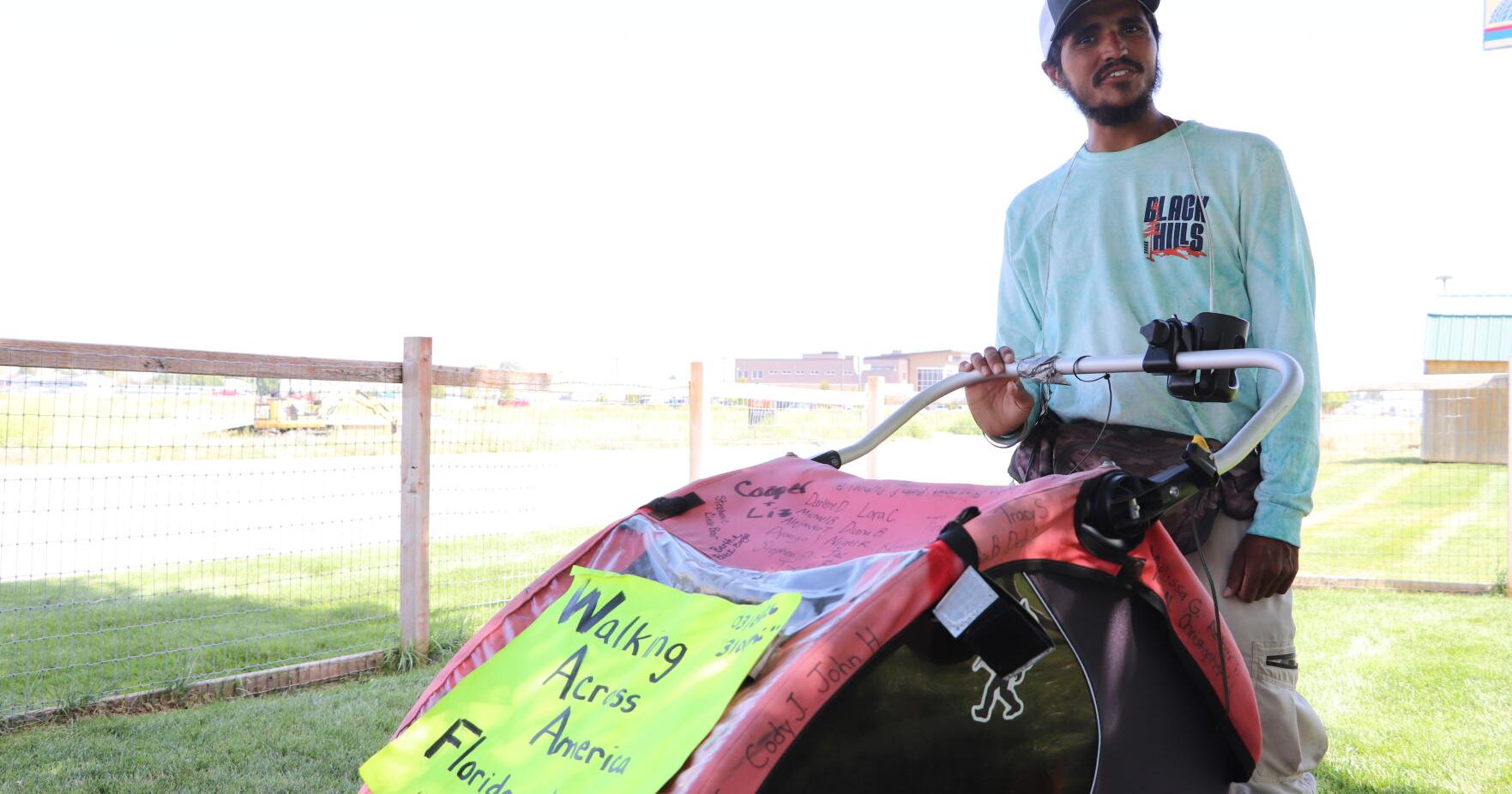
31-летний Камилло Руис преодолел путь от Флориды до Монтаны, собрав более 80 тысяч подписчиков в соцсетях и средства для помощи одиноким родителям с раком. Несмотря на изнуряющие физические испытания и желание сдаться, он продолжает движение к Сиэтлу, чтобы завершить свое путешествие и передать собранные деньги в благотворительный фонд.
Перевод ИИ
Текст статьи доступен на языке оригинала.
Нажмите кнопку «Перевести статью» выше, чтобы сгенерировать перевод с помощью ИИ.
Оригинальный контент
From Orlando to Seattle on foot, ‘Lowlifewreck’ strides through Montana
Camilo Ruiz, 31, spent his entire life within the borders of Florida. Then on March 9, he laced up his shoes and started walking to the other side of the country.
By mid-August, Ruiz had made it from his home in Orlando to the Gallatin Valley, where he stopped for the night in Belgrade. The journey that has now lasted more than five months and thousands of miles started with Ruiz seeing others making the cross-country trek on social media and wondering if he could do it, too.
“Eventually I was like, ‘If I keep just planning, I’m never actually going to do it,’” Ruiz said. “So I just ripped the Band-Aid off and bought some equipment and started walking. It was really just a challenge for myself.”
He keeps his gear in a bicycle trailer built for two toddlers, now covered with signatures and stickers he’s picked up along the way. He started off with the basics — first aid supplies, bear spray and blankets — along with two cameras and a small drone he’s used to document the trip on social media.
His Facebook page has grown from around 150 followers at the start to more than 80,000 now, where he’s known by his handle, “Lowlifewreck.”
The handle, Ruiz said, comes from his time as a stand-up comedian in Florida, referencing the raunchy nature of his humor and the last two letters of his first name. When he started the walk, he considered changing it to something more reflective of the current endeavor and moving away from the adult humor connotation. But ultimately, he decided to keep it.
“I think about the song ‘Amazing Grace,’ where it says, ‘Saved a wretch like me,’” Ruiz said. “That is who I was, so I decided to keep the name. Just to show anyone who feels like a low life or their life’s a wreck or a mess, that it doesn’t have to stay like that.”
For Ruiz, the hard times started early. He was raised by a single mother and ended up living on his own by the time he was 16.
“The first house I lived in was with a bunch of drug addicts, and so naturally, I became a drug addict,” Ruiz said. “I was an addict for probably 10 years, on and off. I would get clean for a little bit, and then the cycle continues. My whole life was just centered around the wrong people and doing the wrong things. No hope for anything, just living day to day.”
Three years ago, Ruiz found himself fed up with addiction and the stagnancy that came with it. He said he didn’t need rehab or a program to achieve sobriety, but just the internal turning point of “choosing not to be a degenerate.” But after the sobriety settled in, he still found himself at loose ends.
“It is a big deal at first, but that can’t make who you are,” Ruiz said. “Because, if we’re realistic, it’s like, ‘What do you want, a cookie?’ There’s plenty of people who never picked up a drug.”
Ruiz said his daily routine hasn’t changed dramatically since he got sober. Even while he was cycling through periods of using and quitting, he never fell into the life of crime or homelessness that he watched drugs drag some of his friends into. He kept working the same job he holds now, as a kavatender, serving tea-based drinks made from the roots of the kava plant. It’s work that pays enough to live comfortably, he said, and puts him in a community interested in the growing popularity of kava as an alternative to alcohol. For Ruiz, the biggest shift with living sober wasn’t the absence of getting high but the loss of the drug-fueled lifestyle.
“Every time I led up to a relapse it was because I was thinking how cool it was to drive two hours into some alleyway in the hood and wait for my guy,” Ruiz said. “Thinking that guy was my friend when he’s not really my friend. And it’s not fun driving two hours, but your brain tricks you into missing that. It feels adventurous, because the alternative when you’re normal is just watching Netflix and going to work.”
Asked directly whether the walk was, in some way, chasing that same sense of adventure without the drugs, Ruiz paused before answering.
“I never thought about it like that,” Ruiz said. “But I did feel like my life was missing adventure.”
Now, having finished a majority of his route from Orlando to Seattle, Ruiz said he’s experiencing a severe case of “senioritis.” He’s gone through multiple pairs of hiking boots, which he wears until there are holes in the bottom, and sustained what he believes to be tendonitis in his ankle from miles walking on uneven, uphill gravel roads. He’s spent countless nights sleeping on a tarp at public parks along his route, living off gas station snacks and occasional cans of tuna. That exhaustion, he said, hit especially hard when he crossed into eastern Montana.
“I’ve had a few moments where I felt like quitting, where I was just like, ‘I don’t know if I can do this,’” Ruiz said. “Eastern Montana was one of those.”
He remembered looking down at his map, the dozens of miles between tiny towns, and looking up at the arid, rocky stretches of land around him that he’d have to walk between them. There were stretches of several days he walked without seeing a single person, an experience he described as “draining and isolating.” By the time he’d walked only a small stretch into Montana, he found himself wondering how much longer he could last.
“Then, I get to Lame Deer,” Ruiz said. “As people find out that I’m there, they all start showing up with gifts and words of affirmation. That was the first great Montana moment I had.”
Lame Deer is the capital of the Northern Cheyenne reservation, home to a tight-knit community of about 5,000 people. When he walked over the reservation line pushing his now-weathered stroller full of supplies, he said word traveled fast and soon people were coming out by the dozens — not only to meet him and take a selfie, but to invite him over for home-cooked meals and Epsom salt soaks for his aching feet.
“The two nights that I was out there, someone let me stay on their front porch. They set up a little cottage,” Ruiz said. “I’ve only done that twice in the last five months. I’ve been offered before, but only taken it twice.”
That stop gave him the boost he needed. The feeling of being on the verge of quitting faded, and over the next week he made his way toward the western part of the state, where he finally saw for himself the Big Sky beauty Montana is known for.
“From Big Timber to here was probably the best stretch on this whole walk, scenery-wise,” Ruiz said. “As soon as you get to Big Timber, you start seeing the mountains in the background. Then once you get a little before Livingston, you’re in it. It’s just so beautiful.”
Still, his final destination feels like a lifetime away. After leaving Belgrade, Ruiz admitted he is anxious about an isolated 100-mile stretch between Anaconda and Missoula, where he will be almost entirely alone in grizzly country. Past that hurdle, nearly 500 miles still remain before Seattle.
It will likely take him another 35 to 45 days. Some mornings, waking sore on his tarp, he wrestles with the same nagging thought, that maybe walking from Florida to Montana is accomplishment enough. Still, he pushes the doubt aside, resolved not only to cross the finish line in Seattle, but to stay present enough to take in the beauty along the way.
“So many people are invested in this, I feel like I’d be letting them down,” Ruiz said. “I’m going to see it through. The only thing that could stop me is if I get hurt or sick.”
Through the social media following he’s amassed, Ruiz has been collecting small donations over the past five months. Early in the walk, he decided to partner with The Singletons, an Arizona-based nonprofit that supports single parents who are battling cancer. Through that partnership, he keeps half of the donated money, with the other half going to the nonprofit when Ruiz’s journey is finished.
“I already know how difficult it is being a single parent, because I watched my mom be one,” Ruiz said. “Then you throw cancer into the mix. So I was like, if I’m going to help raise some money for anyone, I want it to be them.”
When he gets back home to Orlando, Ruiz said he’s looking forward to just spending time with his girlfriend and playing video games on the couch. Still, he has one more trip planned for the future.
“I might drive to Arizona and deliver the check to the charity,” Ruiz said. “Then I’ll finally stay put for like a week in Florida.”
Аналитика ИИ и парсинга
Технические детали обнаружения, сопоставления и связывания статьи
Поисковый запрос
«пешеход Орландо Монтана благотворительность»
Запрос, сгенерированный ИИ для поиска статьи в веб-источниках
Связанные результаты поиска
Это красивая история о юной девочке и её встрече с Орландо Лорен – 12–ти летняя девочка, выжившая после опухоли мозга и жившая с 9 месячного возраста..
Ozon Забота — благотворительность, доступная каждому Хочу помочь О программе Благотворительные сертификаты Посмотреть всё
Орландо находится на 28°24′57″ с. ш. 81°17′56″ з. д. H G Я O (28.533513, −81.375789). Согласно данным бюро переписи населения США, общая площадь города составляет 286,7 км². 265,2 км² из них — суша и 21,5 км² города (7,5 %) — вода. В среднем ...