Английский Наука и Образование
16.07.2026 Читать источник
Компания Benchling призывает научное сообщество использовать «серебряные» данные для ускорения внедрения ИИ
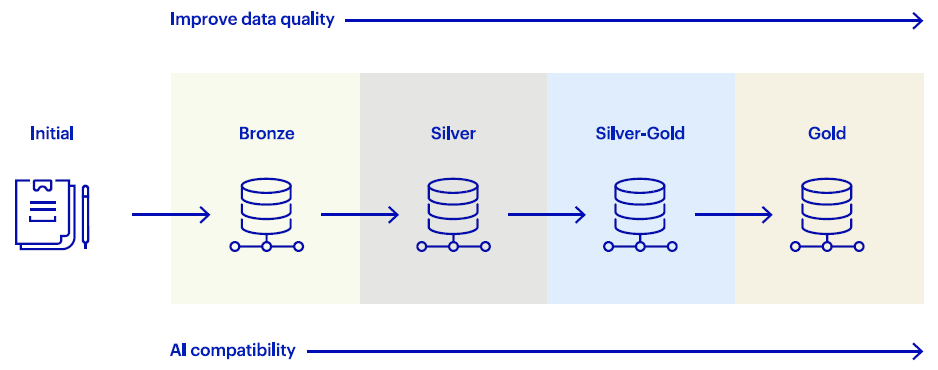
Команда Benchling утверждает, что стремление к идеальному качеству данных парализует прогресс, и предлагает использовать структурированные «серебряные» наборы для автоматизации исследований. Эксперты компании объясняют, что такой подход позволяет постепенно повышать зрелость данных и создавать инфраструктуру для перехода к высшему уровню качества.
Перевод ИИ
Текст статьи доступен на языке оригинала.
Нажмите кнопку «Перевести статью» выше, чтобы сгенерировать перевод с помощью ИИ.
Оригинальный контент
Sponsored Content by BenchlingReviewed by Ify IsiborJul 16 2026
Since accuracy, precision, and reproducibility play essential roles in the life sciences sector, telling researchers to embrace imperfect data may seem counterintuitive.
However, the Benchling team has collaborated with more than a thousand life sciences companies, consulting on their data maturity and helping them enhance and even reconstruct their data approaches.
A common characteristic among successful teams is the understanding that achieving AI-ready data is a journey rather than an instant solution. They work with their current data while advancing toward data maturity goals. A popular belief in the life sciences industry is that only pristine “gold data” is valuable, particularly for AI. However, the reality is that waiting to reach perfect data is a trap.
Instead, teams should embrace “silver data” – structured, contextualized, and interoperable datasets that are sufficient to drive automation, analytics, and AI, without the unrealistic burden of perfection.
The following section details the framework Benchling utilizes to evaluate AI-ready data in life sciences and why silver data, though imperfect, is crucial to reaching data maturity objectives.
How to evaluate data maturity in life sciences
Before obtaining AI-driven insights or automated workflows, evaluating an organization’s data maturity level is the first step. Benchling’s maturity model is derived from Databricks’ medallion architecture for organizing lakehouse data and has been adapted specifically for the life sciences industry.
Image Credit: Benchling
Source: Benchling
The advantages of balancing silver and gold data
Obtaining gold data – fully structured, high-quality, and AI-ready – is the goal of any data-driven organization. However, reaching this state requires overcoming structural and cultural hurdles that stall teams before they even begin.
Gold-level data involves schematization: structuring data into predefined schemas to ensure consistency, traceability, and interoperability. In the life sciences sector, this entails translating diverse experimental workflows and observational data into scalable, machine-readable formats.
However, gold data is not always the immediate or even the correct solution for every scientific workflow. For numerous organizations, silver data serves as a crucial bridge – enabling structure and automation to evolve naturally without disrupting the versatility required for early-stage research and dynamic workflows.
The most sophisticated organizations utilize both silver and gold data strategically: silver for agile workflows and gold for scalable processes.
Silver data
- Well suited for early-stage research, assay development, and exploratory experiments.
- A semi-structured framework introduces consistency without rigid constraints on evolving workflows.
Gold data
- Essential for regulated environments, large-scale aggregation, and AI-driven automation.
- A fully structured framework guarantees traceability, consistency, and interoperability at scale.
Three best practices to transition from bronze to silver data
For clients in the bronze stage who want to progress toward silver and gold data maturity, Benchling recommends starting with the following:
- Basic data organization:
-
- Establish consistent naming conventions.
- Adopt metadata standards.
- Utilize structural templates to ensure searchability and efficient evaluation.
- Avoid siloed storage formats characteristic of bronze-level data.
- Automation and analytics:
-
- Minimize manual entry barriers by introducing automated instruments such as Optical Character Recognition (OCR), Natural Language Processing (NLP), and machine learning pipelines.
- Implement instruments that extract, clean, categorize, and evaluate unstructured records with low effort, eliminating the need for manual input.
- Integration with critical systems:
-
- Ensure compatibility between tools such as electronic lab notebooks (ELNs), laboratory information management systems (LIMS), enterprise resource planning (ERP), and regulatory compliance platforms.
- Focus on seamless data flow to minimize fragmentation and duplication.
Jumping straight to full governance without first addressing naming conventions, data cleaning, and system interoperability results in chaos, frustration, and poor adoption. Implementing Benchling helps in all three areas!
Making the case for silver data implementation
Leadership may worry that focusing on silver-level data could discourage progress toward gold. However, experience demonstrates that silver is a key enabler of gold-level quality.
By incrementally introducing structure and standardization, teams develop the habits and infrastructure required for seamless implementation of gold-level systems. These concerns are common among leaders who are cautious – and Benchling’s responses are exactly what have been shown to be true from 1000+ implementations.
Source: Benchling
Enhancing data maturity for AI readiness: A competitive necessity
The life sciences sector is long overdue for improved data practices. AI-driven insights and next-generation research abilities rely on high-quality data. While many companies remain stuck in the bronze stages of data maturity, using silver data and progressing toward gold is the optimal place to begin.
About Benchling
Benchling makes biotech research and development faster and more collaborative. Biotechnology has the potential to solve humanity’s most pressing challenges, such as disease, renewable energy, clean water, and hunger. The brightest minds are working on these problems but they are equipped with archaic tools. We aspire to fix this and increase the rate of scientific output with a web-based platform that allows researchers to design and run experiments, analyze data, and share results.
Hundreds of thousands of scientists all around the world use Benchling to do research. Whether they are at the world’s largest companies, the top research universities, or working on a startup in a garage, scientists use Benchling for the same reason: to be empowered, not encumbered, by their tools.
Sponsored Content Policy: News-Medical.net publishes articles and related content that may be derived from sources where we have existing commercial relationships, provided such content adds value to the core editorial ethos of News-Medical.net, which is to educate and inform site visitors interested in medical research, science, medical devices and treatments.
Аналитика ИИ и парсинга
Технические детали обнаружения, сопоставления и связывания статьи
Поисковый запрос
«Benchling серебряные данные ИИ автоматизация исследований»
Запрос, сгенерированный ИИ для поиска статьи в веб-источниках
Связанные результаты поиска
В этом дайджесте расскажем о пяти отраслевых модулях, которые автоматизируют рутинные исследования и экономят время специалиста без потери точности.