Английский Криминал
07.09.2026 Читать источник
Водитель GMC Hummer EV удивлен, что Chevrolet Trailblazer в аварии пострадал меньше его электромобиля
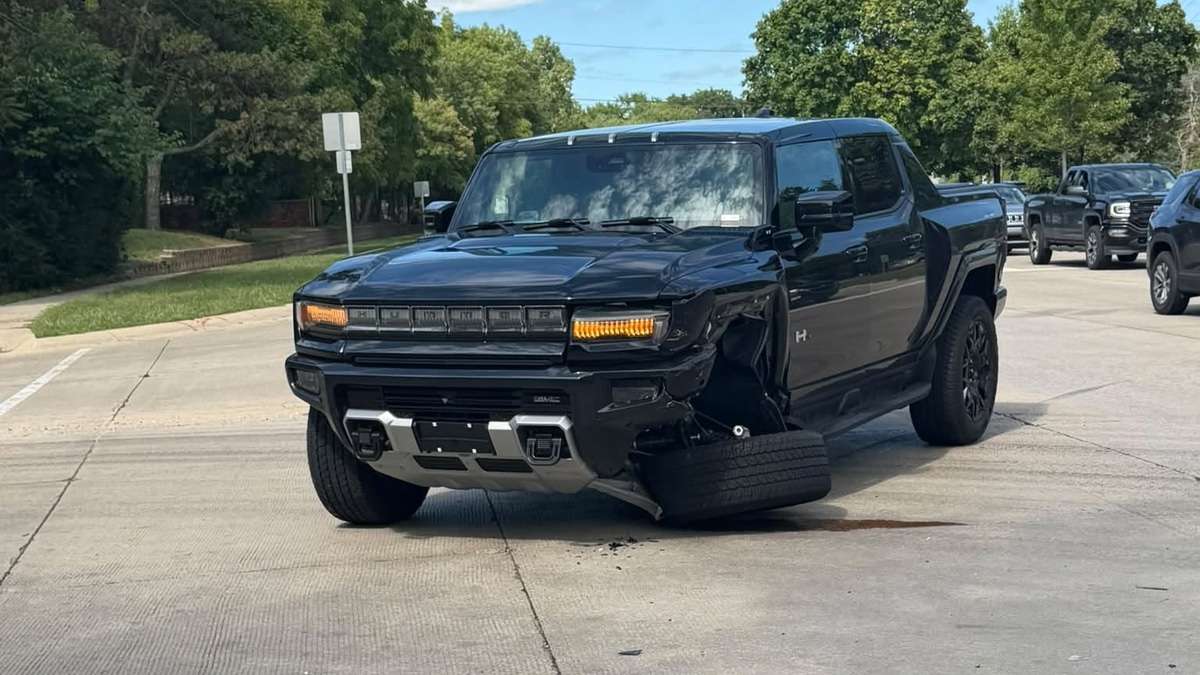
Водитель электромобиля GMC Hummer EV опубликовал фото после столкновения, на котором видно, что его переднее колесо выгнуто, в то время как Chevrolet Trailblazer, участвовавший в ДТП, имеет лишь незначительные повреждения. Журналист отмечает, что видимые деформации не всегда отражают реальную степень ущерба для безопасности occupants и скрытые повреждения, которые могут быть обнаружены только при детальном осмотре.
Перевод ИИ
Текст статьи доступен на языке оригинала.
Нажмите кнопку «Перевести статью» выше, чтобы сгенерировать перевод с помощью ИИ.
Оригинальный контент
2026 GMC Hummer EV Driver Questions Its Toughness After a Chevy Trailblazer Crash at 6,676 Miles
The driver says the Trailblazer looked less damaged than his Hummer. His displaced front wheel highlights the difference between off-road toughness, crash protection, and what it takes to repair a truck.
Advertising
A GMC Hummer EV with one front wheel tilted almost flat against the pavement is a startling sight. Its driver says the truck had just 6,676 miles on it, and the Chevy Trailblazer involved in the collision appeared to have relatively minor damage.
Posting in the Hummer EV Garage Facebook group, Fadi Zaki Zara identified his truck as a 2026 Hummer EV 2X and described a side-impact accident that pushed a front wheel significantly out of position. He questioned whether the suspension and front-end components were as durable as he had expected.
“I bought the Hummer because I expected it to be an extremely robust, heavy-duty vehicle,” he wrote.
There is an important detail in his account that deserves more attention than the jokes in the comments: he explicitly acknowledges that modern vehicles absorb crash energy to protect the people inside. His frustration is with the apparent difference in damage between the two vehicles.
That is a reasonable concern to raise for the Hummer. A truck’s ability to protect people and the difficulty of repairing it afterward are both worth examining. Neither can be graded by comparing the most dramatic-looking broken parts.
The Hummer gives buyers reasons to expect toughness
GMC sells the Hummer EV with substantial off-road capability. Its current product page describes an Extract Mode that raises the truck approximately 6 inches using its air suspension to help it negotiate boulders and other difficult obstacles. Available underbody protection adds to that rugged presentation.
It is easy to understand why someone buying that truck would expect more than imposing bodywork.
But clearing a boulder establishes a different capability from managing a collision. An off-road feature does not tell us how much damage to expect when another vehicle loads a particular corner of the truck.
Crash protection also requires more than making every component resistant to bending. The Insurance Institute for Highway Safety describes a crashworthy design as a combination of a strong passenger compartment, energy-absorbing crumple zones, protective side structure, and a strong roof. Seat belts and airbags must work together to manage the forces on the people inside.
Some structures need to deform. Others need to preserve the space around the people.
That distinction cuts both ways here. An ugly-looking truck can have protected its occupants well. A broken suspension component, however, does not automatically earn credit as a successful safety feature. Establishing that would require evidence about the component’s intended behavior and what actually happened.
The post does not provide an injury account or confirm that anyone walked away unhurt.
Where the wheel goes can matter more than whether it stays intact
Advertising
There is a genuine engineering reason to look closely at wheel movement after a crash.
In a 2016 research paper, IIHS engineers Becky Mueller and Joseph Nolan described wheel and suspension modifications intended to absorb energy and prevent a front wheel from entering the passenger compartment during small-overlap frontal crashes. Their discussion also emphasized strengthening the structures around the occupants.
That research concerns a different crash configuration from the side impact Zara describes. It does not explain this Hummer’s displaced wheel or establish that anything broke deliberately.
It does show why “make the suspension stronger” is an incomplete safety prescription. Engineers have to consider where a wheel travels and how the surrounding structure manages the load, as well as whether the individual parts remain intact.
The measurements used in crash testing reflect that priority. In its small-overlap frontal evaluation, IIHS measures intrusion into the passenger compartment, records injury-related forces through instrumented dummies, and examines how the seat belts and airbags control their movement.
A roadside photograph gives us none of those measurements. It shows the wheel’s final position, rather than the sequence of events that put it there.
For this Hummer, identifying what bent, broke, or separated is the essential next step. Calling it a weak suspension or a textbook example of a crumple zone working would get ahead of that inspection.
The Trailblazer’s appearance leaves part of the comparison missing
The Chevrolet’s apparently minor damage is the driver’s visual assessment. The supplied post does not include a photograph or completed repair assessment of that vehicle, and it does not establish the impact speed.
That matters because visible body damage is only part of a collision repair.
I-CAR, the collision-repair training organization, explains that crash forces can damage components away from the immediate point of impact. Some damage remains concealed until parts are removed. Its guidance emphasizes looking beyond the obvious damaged grille or fender when developing a repair plan.
That possibility applies to both vehicles. It does not establish that the Trailblazer has hidden damage, any more than the Hummer’s wheel position establishes that its frame is damaged.
Vehicle weight adds another distinction. IIHS says that, other things being equal, a heavier vehicle generally gives its occupants an advantage in a collision with a lighter vehicle because of the forces they experience. That is an occupant-protection advantage, not a promise that a particular wheel or suspension component will survive the contact.
There is no need to invent curb weights for these two vehicles to explain the principle. A larger truck can sustain conspicuous mechanical damage without that appearance telling us which vehicle better protected the people inside.
The mounting points could change the repair picture
Advertising
For the Hummer’s driver, one particularly useful distinction will be damage to replaceable suspension or steering components versus damage to the structure where those components attach.
I-CAR’s guidance on damaged steering and suspension mounting locations treats those areas as safety-sensitive. It calls attention to continuing loads, the consequences of incorrect mounting, and the vehicle manufacturer’s repair restrictions. Something that can be made to look straight is not necessarily suitable for a safe repair.
An inspection that identifies the failed parts and checks the mounting locations would move this discussion forward. A documented repair plan and estimate would then give the driver something more useful than guesses about whether the truck is totaled.
Zara has already identified that missing information. In the post, he says he does not yet know whether the frame or suspension mounting points were damaged.
“I’ll know more after the teardown,” he wrote.
The comments predicting a total loss are still predictions. No completed estimate or insurer decision appears in the supplied account.
Even a confirmed good outcome for the people involved would leave legitimate ownership questions: which parts need replacing, whether structural repairs are required, how long the work will take, and what it will cost. Protecting people is the first priority. Repairability still matters to the person who bought the truck.
For now, the Hummer’s striking wheel position deserves a proper mechanical explanation. It gives the driver a reason to ask questions, but it cannot answer them on its own.
A truck can protect people well and still be expensive to put back on the road. Buyers have every reason to care about both. Whether the other vehicle came away looking worse is a poor substitute for either assessment.
Have you had a wheel-impact collision in a Hummer EV or another pickup? Share the model year, what the repair shop found, and whether the vehicle was repaired or totaled. The inspection findings would be especially useful.
One photo by Fadi Zaki Zara
About The Author
Noah Washington is an automotive journalist based in Atlanta, Georgia, covering sports cars, luxury vehicles, and performance culture. His reporting focuses on explaining the engineering, design philosophy, and real-world ownership experience behind modern vehicles.
Noah has been immersed in the automotive world since his early teens, attending industry events and following the enthusiast communities that shape how cars are built and driven today. His work blends industry insight with enthusiastic storytelling, helping readers understand not just what a car is, but why it matters.
Noah is also a member of the Southeast Automotive Media Association (SAMA), a professional organization for automotive journalists and industry media in the Southeast.
His coverage regularly explores sports cars, luxury vehicles, and performance-driven segments of the automotive industry, including the evolving culture surrounding Formula Drift and enthusiast builds.
Read more of Noah's work on his author profile page.
You can also follow Noah here:
Advertising
Set Torque News as Preferred Source on Google
Аналитика ИИ и парсинга
Технические детали обнаружения, сопоставления и связывания статьи
Поисковый запрос
«GMC Hummer EV Chevrolet Trailblazer авария сравнение повреждений»
Запрос, сгенерированный ИИ для поиска статьи в веб-источниках
Связанные результаты поиска
Страховщики рассказали, какие автомобили — с ДВС, электрокары или гибриды — чаще попадают в серьезные ДТП и нуждаются в дорогом ремонте
Страховщики рассказали, какие автомобили — с ДВС, электрокары или гибриды — чаще попадают в серьезные ДТП и нуждаются в дорогом ремонте