Английский Культура
26.08.2026 Читать источник
Граффити-художник Riot Top Two: три десятилетия в Джоханнесбурге и планы на Африку
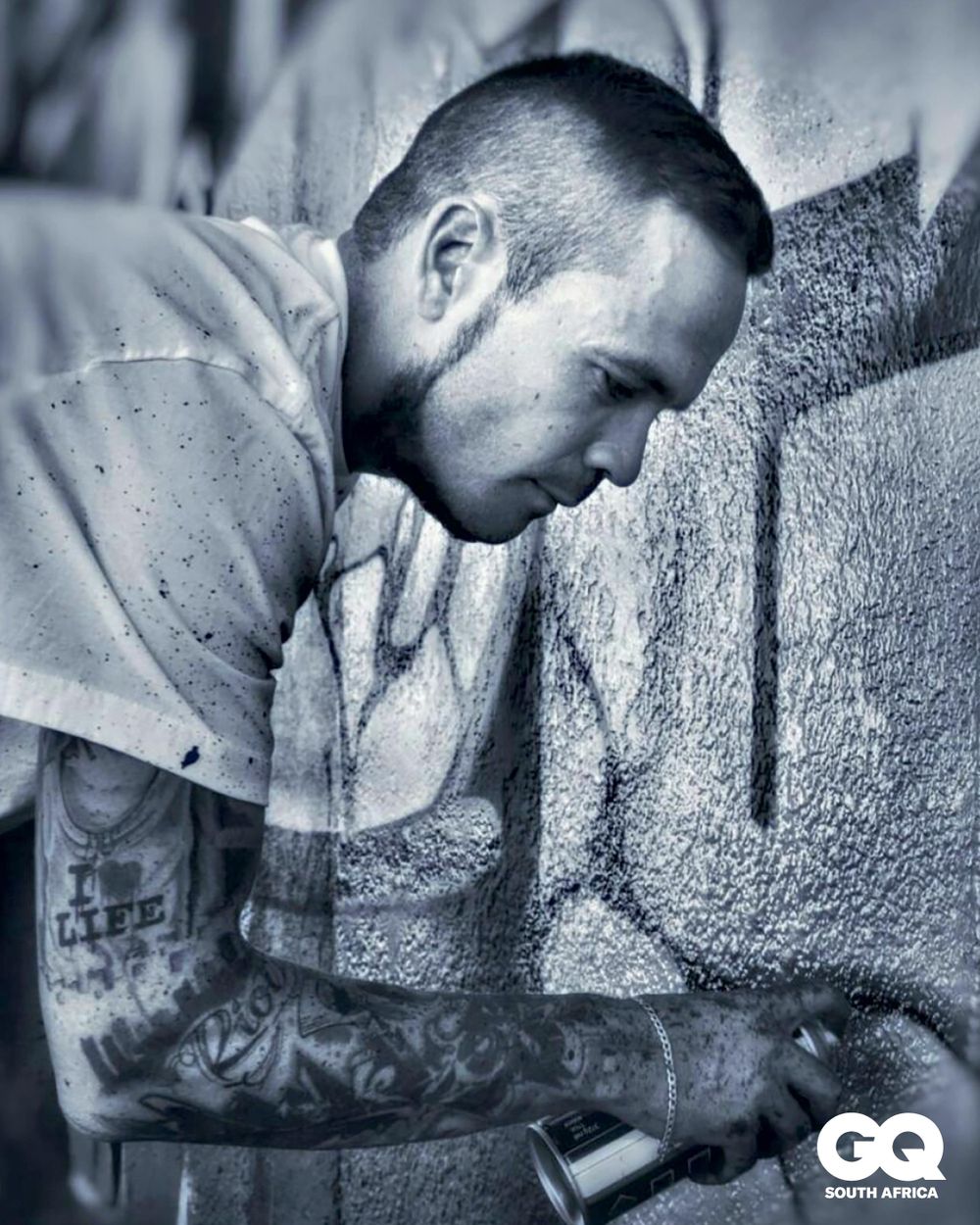
Известный южноафриканский художник Чарльз Кейлок, известный как Riot Top Two, продолжает создавать масштабные муралы в Джоханнесбурге уже более 30 лет. Несмотря на философское отношение к временному характеру уличного искусства, он планирует новые проекты по всей Африке и поездку в Европу.
Перевод ИИ
Текст статьи доступен на языке оригинала.
Нажмите кнопку «Перевести статью» выше, чтобы сгенерировать перевод с помощью ИИ.
Оригинальный контент
GET THE LATEST ISSUE OF GQ
Charles Keylock
Image: Supplied
Charles Keylock, known in the graffiti world as Riot Top Two, has been painting walls longer than most people stick at anything. Three decades in, he’s one of Johannesburg’s most recognisable mural artists, his tag RIOT a fixture across the city. He works across murals, canvas, live painting, stencils, portraits and tattoos, with his work now spread across South Africa and beyond.
Born in East London in 1985 and relocated to Johannesburg at age eight, he came up in a city that didn’t offer much and expected you to take what you needed from it. He found graffiti the way most kids find it: through older friends, paper sketches, and the slow realisation that he was actually good at it.
Five years of drawing came before he ever picked up a can. Then one wall, and he never stopped.
His biggest obstacle along the way? “Myself,” he says. “It took time to mature and find the confidence in my art, although the drive to be better at this medium helped me in all aspects of my life. I’m way more disciplined, calm and focused.”
The range of formats he works across is less a creative statement and more a practical one, he says. Surviving as a commission artist in South Africa means going where the work is. Given the choice, he’ll take a well-prepped, sizable outdoor wall every time.
“Through the years I considered my style to be pretty much traditional graffiti. In the last five years all the commissioned work I have been fortunate enough to be a part of taught me a lot more about portrait art and putting together a wall as a whole, allowing space and colour to work off each other.
“I think the mix of graffiti and contemporary need to be well balanced in order to work together. When they are, it’s beautiful and a lot easier to relate to than just graffiti.
“What has inspired me along the way is the international scene as well as my peers. To be considered on the international line up is all the fuel I needed. If you have a close friend who is into the same thing, that competition is healthy. It keeps you on your toes and pushing to be better.”
“At heart I’m still a graffiti artist. I still go out and find spaces that need some colour and do my thing. Some don’t agree with doing commission-based work but I say without the commissions who’s paying for all that paint? Without that paint coming in constantly there’s no growth.
“Graffiti is for anyone and they can choose any route they want. That is the beauty of it.”
Asked about the debate between graffiti as vandalism and street art as ‘culture’, he says that there is a difference between graffiti and street art and is unmoved by the idea that unsanctioned work is somehow more authentic.
“I’m going to get some heat by saying this, but I’ve never understood why graffiti artists thought if it’s illegal it’s better. Preparing a wall, getting permission, and taking a few days to enjoy yourself is just as nice.
“When we get older and it’s harder to run, we call it street art,” he laughs. “I’m for both, art is for everyone.”
Large-scale work is where RIOT feels most himself. He says he prefers large wall spaces, and describes the shift from intimidation to invitation as something that comes with both mental and physical conditioning.
Once you’ve worked through a few big murals and seen what colour can do to a space and the people moving through it daily, he says, the blank wall stops being a problem and starts being a platform. In that sense, graffiti has always been a live show for whoever is passing.
“You get conditioned to working with an audience and over time the crowd becomes part of the process rather than a distraction,” he says. “I think it’s healthy to have an audience at times with no choice but to lock in. Focus is everything in this medium.”
He’s upfront that his creative process is built around preparation rather than spontaneity. The right materials, a considered colour palette and a strong design are what set him up.
Once he’s painting, the focus is total, but it has a way of slowing everything down, giving him space to think more clearly. As for hidden meanings, there are none. There’s enough going on in the world already. “What my art would say about me, if it could speak, is high energy, movement, precision, inspiring, next level.”
On how the city influenced his art, he says that growing up in the Johannesburg scene makes you tough.“No one gave an inch back in the day. I never agreed on that narrative. That being said, I went harder, bigger, better. I started changing that slowly.
“Within the circles I’m in, we started helping each other out and doing commissions together, and became stronger artists because of it. I’m sure I’d be a different artist in a different city with different challenges.”
Does he think about the strangers who never asked for his work but now live with it as part of their daily landscape? “Yes, I actually find myself thinking about that a lot while painting, as well as what type of impact it has on them. I’m hoping it’s positive. How many artists will my work inspire? Seeing graffiti daily is what inspired me as a youth to put those sketches on a wall, so hopefully my art has a similar effect.”
On permanence, he’s philosophical without being sentimental. Graffiti and street art don’t live forever, he says, and getting attached to the idea that they will is a mistake. When it’s gone, keep moving. What matters is consistent output for as long as possible.
Looking ahead, RIOT has a dream project in mind: travelling South Africa to paint the Big Five at game reserves across the country. More immediately, he’s planning a personal trip to the Okavango Delta in Botswana, getting married to his fiancée early next year, and after that, his eye is on Europe. The culture there, he says, is bigger, and he wants to experience more of it.
Related Topics:
Аналитика ИИ и парсинга
Технические детали обнаружения, сопоставления и связывания статьи
Поисковый запрос
«Риот Топ Тво художник Йоханнесбург граффити»
Запрос, сгенерированный ИИ для поиска статьи в веб-источниках
Связанные результаты поиска
Йоханнесбург: Уличное искусство и культура в Мабоненге! Мы встречаемся в местной популярной кофейне Home of the Bean Coffee, где гости смогут насладиться вкусной чашечкой кофе перед началом экскурсии! Затем мы отправимся на ...