Английский Наука и Образование
27.08.2026 Читать источник
Астронавты NASA разработали чашку с капиллярным потоком для кофе в невесомости
Инженеры NASA создали специальную чашку, использующую капиллярный эффект, чтобы астронавты могли пить кофе в космосе без проливаний. Данное изобретение, запатентованное после экспериментов на МКС, также применяется для оптимизации расхода топлива в ракетных баках и дозирования лекарств.
Перевод ИИ
Текст статьи доступен на языке оригинала.
Нажмите кнопку «Перевести статью» выше, чтобы сгенерировать перевод с помощью ИИ.
Оригинальный контент
Listen to this article in summarized format
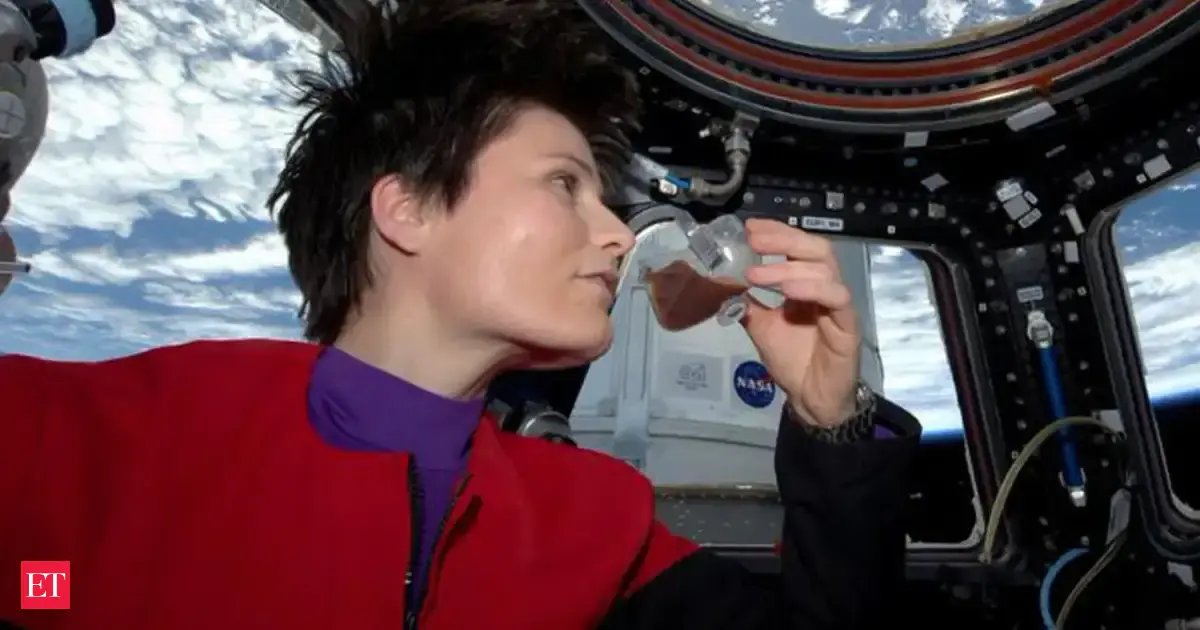
The cup was used with ISSpresso, an espresso machine built in Turin, Italy by the firm Argotec in partnership with Lavazza, which launched to the space station aboard a SpaceX cargo flight in April 2015 and arrived in early May 2015, according to NASA and Italian Space Agency records. ESA astronaut Samantha Cristoforetti later used the machine and cup, and a widely circulated photo shows her sipping espresso beside the station's Cupola window.
Why coffee refuses to behave in orbit
On Earth, gravity pulls liquid downward and keeps it in a cup. In microgravity, that force is almost non-existent. Instead, liquid clings to surfaces because of surface tension, the tendency of molecules to stick together and to nearby surfaces. Tipping a regular cup in space would not spill the coffee. It just stays there, stubbornly stuck in place. This led NASA to rethink the cup design. A NASA technical brief on the invention states that astronaut Don Pettit came up with the first version of a solution while living on the station, and researchers Mark Weislogel, with mathematical consultants Paul Concus and Robert Finn, helped to refine the idea into a patented design. Their invention uses the same physics that makes water climb a thin straw or a paper towel soak up a spill, known as capillary flow.
The ISSpresso machine aboard the space station, used to brew coffee and espresso for the crew. Image Credits: Italian Space Agency, ASI
The final version, sometimes dubbed the 'Space Cup', was 3D-printed from food-safe plastic. Researchers writing in Frontiers in Space Technologies, in a study titled 'Microfluidics and Macrofluidics in Space: ISS-Proven Fluidic Transport and Handling Concepts,' explain that the cup has a narrow, tapered interior corner from the base to the rim. That shape creates a constant capillary pressure gradient, drawing liquid along the corner to the lip without a pump or gravity. When the liquid reaches the top, the forces balance and the flow stops until the astronaut takes another sip.
The NASA blog post reports that six of these cups were already aboard the station and ready for use by the time the post was published in May 2015. The cups were part of a formal experiment called the Capillary Beverage investigation, designed to gather real data about how complex fluids flow in the absence of gravity, beyond just making coffee easier to drink.
Samantha Cristoforetti drinks coffee from a pouch aboard the space station, the old way, before the capillary cup. Image Credits: NASA
Would space espresso even look the same
Weislogel's post also raises a fair question: would the espresso even develop the crema, that thin layer of foam on top of a well-made shot? Unlike the coffee itself, which stays in continuous contact with the cup's corner as capillary action pulls it along, the tiny bubbles that form crema need buoyancy to separate and coalesce into a stable foam layer, a force that's minimal in microgravity. The blog says this makes crema unlikely, so the coffee might look different even if it tastes the same.
Why this matters beyond the coffee cup
Weislogel's post says the data from the Space Cup experiment was fed into math models that help engineers design how liquids move inside containers. Two practical applications stand out: completely emptying rocket fuel tanks, since any fuel left over is wasted weight and money, and delivering accurate doses of medication where the exact amount is crucial. WIRED magazine later named the design one of the most cleverly designed objects of 2015.
It’s easy to read as some fun piece of space trivia and move on, but it's actually a neat case of simple physics quietly solving a real problem. Astronauts wanted coffee that behaved more like it does at home, and that goal drove the engineering work. Next time you take a sip of coffee, remember that scientists had to study surface tension to make it possible in space.
(Catch all the US News, UK News, Canada News, International Breaking News Events, and Latest News Updates on The Economic Times.)
Download The Economic Times News App to get Daily International News Updates.
(Catch all the US News, UK News, Canada News, International Breaking News Events, and Latest News Updates on The Economic Times.)
Download The Economic Times News App to get Daily International News Updates.
Аналитика ИИ и парсинга
Технические детали обнаружения, сопоставления и связывания статьи
Поисковый запрос
«NASA астронавты чашка кофе невесомость»
Запрос, сгенерированный ИИ для поиска статьи в веб-источниках
Связанные результаты поиска
National Aeronautics and Space Administration, сокр. NASA (НАСА)) — независимое агентство федерального правительства …