Английский Технологии
07.09.2026 Читать источник
В Шэньчжэне открыт высокотехнологичный склад для хранения микроэлектроники
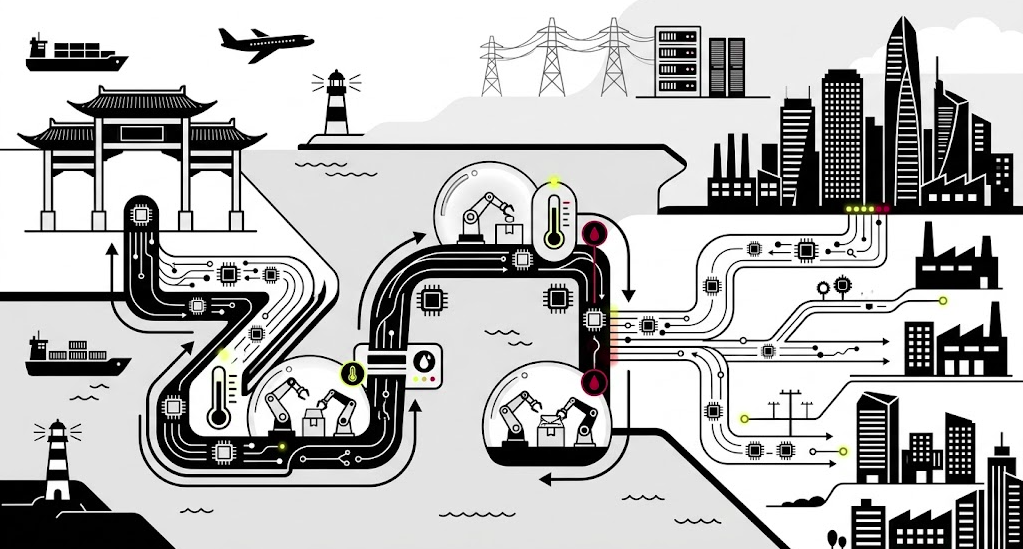
Логистическая компания Kejie запустила специализированный склад в районе Наншань Шэньчжэня для безопасной транспортировки хрупких полупроводников. Новое предприятие оснащено климат-контролем и системами защиты от статического электричества, что позволяет доставлять чипы к производственным линиям в течение нескольких часов.
Перевод ИИ
Текст статьи доступен на языке оригинала.
Нажмите кнопку «Перевести статью» выше, чтобы сгенерировать перевод с помощью ИИ.
Оригинальный контент
Shielding China's $424 Billion Microchip Lifeline with Controlled Supply Chain
A single shipping crate of advanced silicon microchips can easily command a price tag in the hundreds of thousands of dollars, yet it remains one of the most fragile commodities in global commerce.
A stray burst of static electricity or a minor spike in ambient humidity can instantly ruin millions of dollars of cutting-edge circuitry, rendering precision components completely useless before they ever reach an assembly line. As global semiconductor demand surges past $795.6 billion, the push to safeguard these components in transit has moved out of standard cargo bays and into specialized, software-driven cleanroom facilities.
Kejie Logistics, the supply chain division of Digital China Holdings, just opened a dedicated semiconductor warehouse in Shenzhen’s Nanshan District. The facility operates alongside Kejie's existing hub at the Hutchison Logistics Centre in Kwai Chung, Hong Kong, forming a dual-warehouse logistics network that spans South China’s primary hardware gateways and helps the domestic industry control the supply chain. The expansion comes as China cements its position as the world’s largest consumer of integrated circuits, importing $424.33 billion worth of semiconductors in a 10.1 percent year-over-year increase that keeps microchips as the nation's single largest imported commodity.
Shenzhen alone accounts for 819.27 billion yuan, or roughly $115 billion, in integrated circuit imports following a 19.5 percent annual surge.
Located in Nanshan District near major technology conglomerates and chip design firms, the new facility sits minutes away from the advanced manufacturing floors of Bao'an and the component markets of Huaqiangbei. Together with the Hong Kong facility, the combined dual-warehouse footprint exceeds 22,000 square meters. Its proximity to deep-water shipping ports, international airports, and border checkpoints allows incoming global chip shipments to reach mainland production lines within hours.
Protecting silicon integrity inside these spaces requires strict environmental controls. Storage zones are fully sealed, locking ambient temperatures between 15 and 28 degrees Celsius, with daily fluctuations capped at 5 degrees. Relative humidity stays strictly between 40 and 60 percent. Moisture-Sensitive Devices stripped of original factory seals undergo immediate vacuum anti-moisture packaging alongside Humidity Indicator Cards. Electrostatic discharge defense is similarly rigorous, requiring warehouse personnel to pass ESD wrist-strap verification before entering handling zones equipped with non-conductive tools and static-shielding materials.
Digital tracking relies on Kejie’s proprietary Shenzhou Jinku software platform, establishing an unbroken data chain from initial intake to final outbound delivery.
Upon arrival, every shipment is scanned to record its origin and model, generating a unique outer-box barcode linked to two-way batch tracking and a strict First-In, First-Out inventory protocol enforced through daily stock audits. Operations teams also perform specialized on-demand kitting, custom sorting, and barcode or QR code labeling tailored to the distinct inventory requirements of original equipment manufacturers and component distributors.
The initiative builds on Kejie's two-decade track record in high-tech supply chain infrastructure, managing over 500 billion yuan in assets for more than 100 Fortune 500 clients across 200 nationwide warehouses. Driven by rapid import-export growth across South China, Kejie's financial reporting reflects double-digit revenue and profit expansion within its specialized semiconductor division. As global hardware manufacturing demands tighter turnarounds and strict compliance, specialized logistics facilities equipped with granular software tracking and physical environmental defense have become as essential as the semiconductor foundries themselves.
Аналитика ИИ и парсинга
Технические детали обнаружения, сопоставления и связывания статьи
Поисковый запрос
«Шэньчжэнь склад микроэлектроники Kejie»
Запрос, сгенерированный ИИ для поиска статьи в веб-источниках
Связанные результаты поиска
Маршрут Шэньчжэнь — Россия для электроники остаётся одним из самых нагруженных направлений из Китая: отсюда идут смартфоны, дроны, платы и носимые гаджеты. Ниже — актуальные тарифы, транспортные схемы и обязательные требования таможни на 2026 год.